
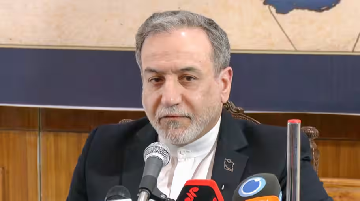

Iranian Foreign Minister Seyyed Abbas Araghchi will visit China on September 16 and hold talks with his Chinese counterpart Wang Yi, China’s Ministry of Foreign Affairs said on Tuesday.
In a statement posted on X, the Chinese Foreign Ministry said Wang, a member of the Political Bureau of the Communist Party of China Central Committee, will meet Araghchi during the Iranian minister’s visit.
Araghchi’s visit comes ahead of Chinese President Xi Jinping’s expected trip to the United States on September 24, where he is set to meet US President Donald Trump.
Trump announced the date while speaking to executives from the US travel sector earlier this month. He said he expected the meeting with Xi to yield positive results.
“By the way, we have the president of China coming on the 24th; it’ll be very exciting and be great, and I’d love to have him,” Trump said.
The talks between Araghchi and Wang come amid heightened tensions in West Asia following Iran’s military confrontation with the United States. Tehran has been engaging with key partners diplomatically as instability continues across the region.
Araghchi and Wang last met on the sidelines of the Shanghai Cooperation Organisation (SCO) Foreign Ministers’ Meeting in Kyrgyzstan in July. Araghchi also held a pull-aside meeting with Wang on the sidelines of the BRICS Summit.
The Chinese foreign minister’s meeting with Araghchi follows Iran’s participation in the 18th BRICS Summit in New Delhi, where Iranian President Masoud Pezeshkian led the country’s delegation.
Addressing the summit, Pezeshkian urged BRICS members to take practical steps against what he described as unilateral and “inhumane” sanctions. He also called for a stronger role for the grouping in addressing global conflicts.
Pezeshkian said BRICS members had a responsibility to oppose the normalisation of attacks on civilian infrastructure and peaceful nuclear facilities, arguing that such actions posed a direct threat to international peace and security. He also highlighted the Palestinian people’s right to self-determination and called for a more active BRICS role on the issue.
BRICS leaders unanimously adopted the New Delhi Declaration 2026 at the summit. The declaration called for reforms in global governance and greater representation for developing countries.
It also expressed deep concern over rising tensions in West Asia and called for maximum restraint, protection of civilians and civilian infrastructure, and respect for sovereignty and territorial integrity. The declaration further stressed the need to maintain the smooth flow of global trade, supply chains and energy in line with international law.
On the sidelines of the summit, Pezeshkian met Prime Minister Narendra Modi, with the two leaders discussing bilateral relations and developments in West Asia.
Modi stressed the need for continued efforts towards lasting peace and stability in the region. He also underlined the importance of freedom of navigation, uninterrupted commerce and the safety of seafarers amid tensions affecting the strategically important Strait of Hormuz.
Against this backdrop, Araghchi’s talks with Wang are likely to provide Beijing and Tehran an opportunity to exchange views on regional developments and wider international issues ahead of Xi’s expected engagement with Washington.