
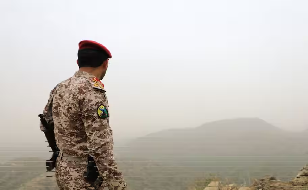

Bringing more fighting to parts of Yemen, Houthi forces are advancing towards Saudi-backed government positions in Marib and Taiz. The developments come at a difficult time for Saudi Arabia, which is also dealing with Houthi attacks and the ongoing confrontation between Iran and the United States.
The reported Houthi movement towards Marib has raised fears of another major offensive in the province, which has been one of the most important government-held areas since Yemen’s war intensified in 2015. The province has major army bases, oil and gas fields and an important power station. More than 2 million displaced people are also based here
Yemeni forces brace for possible offensive
Reports of Houthi forces gathering around Marib have prompted Yemen’s government forces to prepare for a possible attack. Military officials say the army has gained extensive battlefield experience during more than a decade of fighting.
Brigadier Yahya Al-Hatemi, director of the Yemeni army’s military media, told Arab News that government forces have become more capable through years of combat.
“The armed forces have generally become more organised, powerful and effective,” he said.
He added, “Over the past decade, they have gained combat experience that enabled them to overcome adversity, master military tactics and identify the enemy’s strengths and weaknesses.”
Yemeni media reports over the weekend said the Houthis have moved large numbers of fighters and military equipment into areas of Marib province under their control. The reports have raised the possibility of preparations for another offensive.
The reported buildup followed Houthi advances along Yemen’s western coast, including the seizure of the Red Sea port city of Mokha and movement towards the Bab Al-Mandab area.
Al-Hatemi said the army is aware of the possibility of a push towards Marib. “We know that the new pressure will be directed at Marib,” he said.
He said government forces have enough military strength and local backing to defend the province.
“However, Marib has significant military strength and divine protection. Moreover, the Houthis lack a popular support base there. Quite the opposite: The local environment is hostile to them,” he said.
Saudi Arabia faces a difficult choice
The situation has also created a difficult military and political calculation for Saudi Arabia. According to CNN, the Houthi advance and attacks on Saudi Arabia have left Riyadh with limited options, with any military response carrying its own risks.
Experts cited by the publication said the kingdom does not want an all-out war. Houthi advances could draw the Gulf kingdom into a larger confrontation.
Mohammed Al-Basha, a Yemen expert and Washington, DC-based risk adviser, told CNN, “All signs now point to a large-scale Saudi retaliation, and that likelihood is increasing by the day.”
The developments in Yemen are taking place along with the continuing confrontation involving Iran and the United States. The military operations is also affecting commercial shipping through the Strait of Hormuz, one of the world’s most important routes for oil shipments.
101 commercial vessels redirected
US Central Command (CENTCOM) said that 101 commercial vessels has been redirected by the US Navy in the Strait of Hormuz as of Sunday (September 13) local time. The United States reinstated its blockade on Iranian ports in July after talks between Washington and Tehran broke down.
During his two-day visit to Ireland on September 12, US President Donald Trump discussed Iran, the Houthis and the situation in the Strait of Hormuz along with Irish Prime Minister Micheál Martin at a joint press conference at Farmleigh House.
Asked about Iran’s role, he said Tehran is probably responsible and said the Houthis have contacted Washington to make clear that they do not want a confrontation with the United States.
“I think they are probably. They are on the balls of their feet right now, but I think they are. They’ve been in charge of that for a while. We’ve had discussions. The Houthis called us, and they don’t want to fight with us. They let us know. They don’t want to fight with us. They don’t want me to go after them. They don’t want us to go after them. But they’ve called and they’ve talked to us, and they don’t want us to. They would much prefer not having us involved,” he said.
The president said most commercial ships are being allowed to pass through the waterway. He also said the United States is taking action against vessels it considers problematic.
“And they’re letting most ships go through. There’s just one country that they’re not too happy with, and we’ll get that straight down. But I have to say we’ve done a great job here,” he said.
Trump also referred to the US naval blockade and Washington’s control of the waterway, saying the action has prevented oil prices from rising further.
“We really very powerfully control our most straight, and nobody saw that happening. But we have very powerful control over it. We have a naval blockade that’s been so incredible,” he said.
Describing the scale of US naval operations, he said American forces are intercepting a large number of vessels each day.
“Boy, your oil prices would be much higher. We’re taking a lot of boats out. We take out, on average, 25 boats a day, most of them at night,” he said.
Preliminary ship-tracking data cited by Al Arabiya English in a Facebook post on September 10 showed that vessel traffic through the Strait of Hormuz has fallen to seven from 12 the previous day. The number is also below the 10-day average of 14.
The developments in Yemen are unfolding along with the fighting and military moves involving Iran, Saudi Arabia and the United States. Any further Houthi advance towards Marib or attacks stemming from the ongoing conflict could bring more military activity across the region.