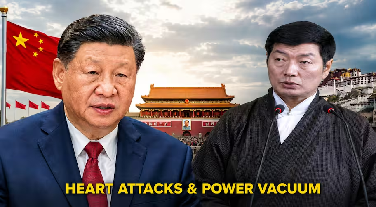

In an astonishing announcement, Dr Lobsang Sangay, who served as the Prime Minister (Sikyong) of the Central Tibetan Administration, reported that the Chinese President, Xi Jinping, had suffered two heart attacks. During an intensive media interaction in New Delhi, Dr. Sangay revealed that the immense pressure of governing and mental exhaustion have heavily influenced the physical well-being of the Chinese president, leading to erratic purging in government administration and further deepening the political vacuum in Beijing
Health issues and purges in Beijing
Referencing the poor health condition of President Xi, Dr Sangay mentioned how immense bureaucratic pressure and exhaustion at the highest levels have heavily affected his physical well-being. According to information passed to him by a former senior member of the Chinese administrative body, President Xi has experienced “two heart strokes.”
Due to this increasing physiological and cognitive burden, President Xi has been experiencing “mental fog,” leading him to initiate a drastic purging of several senior military generals and defense ministers that he himself chose.
Within the closed circle of Beijing politics, the military chiefs and security officers exercise total power, and the Chinese president is working in a political bubble.
‘Emperor’s dilemma’ and succession
Concerning Beijing’s transition strategy, Sangay argued that China is caught in a typical structural dilemma which the author referred to as the “Emperor’s Dilemma.”
The hazard of naming a successor: In autocratic political systems, naming a crown prince has always resulted in internal coups and assassination.
The consequences of remaining silent: By remaining silent on naming a successor, the ruler can remain in power for an extended period of time; however, this strategy ultimately leads to a political impasse and civil war when the vacuum of power appears.
It is this structural dilemma that explains why China has not yet announced a clear successor.
Context
Central Tibetan Administration operates from Dharamshala, India, after the 1959 Lhasa uprising during which the Dalai Lama and many Tibetans fled from the Chinese military oppression. Although the existence of the exile government has been consistently rejected by Beijing, political changes within China are observed by the exile leaders.