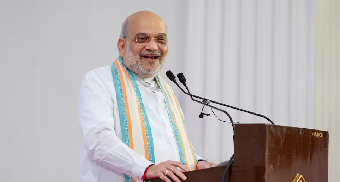

Union Home Minister Amit Shah on Sunday said the Uniform Civil Code (UCC) would be implemented in all 21 states governed by the BJP-led NDA before 2029, while asserting that India’s approach to terrorism and national security has undergone a major shift in recent years.
Addressing an event in Mumbai, Shah said the government had already introduced the UCC in several states and expressed confidence that the remaining NDA-ruled states would also adopt it before 2029.
“We introduced the Uniform Civil Code (UCC) in several states. I am confident that we will implement the UCC in all 21 states governed by the BJP-led NDA before 2029,” Shah said.
His remarks come as the BJP-led government continues to push the UCC as a major policy objective, alongside its focus on governance, national security and institutional reforms.
‘Seva Sankalp Abhiyan’ from September 17
Earlier, Shah announced a month-long nationwide campaign, the Seva Sankalp Abhiyan, from September 17 to October 17 to mark Modi’s completion of 25 years in continuous public service.
The campaign will be conducted across states and Union Territories, districts, Lok Sabha and Assembly constituencies and down to the polling-booth level. Shah said the NDA, voluntary organisations and people across the country would participate in the initiative.
The campaign will begin on September 17, Modi’s birthday, and run until October 17. October 6, 2026, marks 25 years since Modi first took charge as Chief Minister of Gujarat in 2001, beginning a continuous political career spanning state and national office.
‘Zero tolerance’ towards terrorism
Shah also highlighted what he described as a decisive change in India’s security policy, pointing to operations such as the surgical strikes, air strikes and Operation Sindoor as examples of the country’s response to terrorism.
“Operations such as the surgical strikes, air strikes, and Operation Sindoor have established a policy of zero tolerance towards terrorism, while security has been prioritised across various sectors,” he said.
The Home Minister said India now had a robust policy to deliver a befitting response whenever Indian soldiers or citizens were targeted in terrorist attacks or conspiracies. He also cited the government’s handling of Article 370, Naxalism and the situation in the Northeast as key areas where he said long-standing internal security challenges had been addressed.
‘Politics of performance’ after 2014
Shah contrasted the political landscape before 2014 with the period since Narendra Modi became Prime Minister, arguing that national politics had shifted from issues such as corruption, casteism and dynastic politics towards what he termed “politics of performance”.
“Prior to 2014, our national politics was plagued by corruption, casteism, and dynastic politics. In the political era spanning 2014 to 2026, the nation has moved beyond these issues towards a politics of performance,” Shah said.
He also pointed to India’s economic performance, saying the country had moved from being counted among the “Fragile Five” economies to becoming one of the world’s top five economies. Citing recent first-quarter figures, Shah said India had recorded GDP growth of 7.8 per cent, leading major economies.
‘India First’ approach to foreign policy
The Home Minister said the country’s economic rise had been accompanied by a stronger approach to foreign and defence policy, with national interest at its core.
“For the first time in 12 years, the people have witnessed a foreign policy with a strong backbone. Whether it is our defence policy or our foreign policy, the guiding principle is ‘India First’. India’s interests are paramount to us,” he said.
Shah also claimed that India’s standing on the global stage had risen significantly over the past 12 years. He said India’s voice carried greater weight on international issues and pointed to the global recognition received by Prime Minister Narendra Modi.
According to Shah, Modi has a 68 per cent approval rating in surveys and has received the highest international honours from 36 countries. He said the recognition reflected what he described as India’s growing stature globally.
Bike Yatra from Kashi to Vadnagar
As part of the wider campaign, the BJP will also undertake grassroots programmes in the Kashi region focusing on public service, welfare initiatives, governance achievements and the roadmap for Viksit Bharat.
A major Bike Yatra from Kashi to Vadnagar will begin on September 17 after ritual offerings of water from 10 rivers at the Kashi Vishwanath Temple. The yatra will pass through several states before concluding on October 7 at Vadnagar in Gujarat, Modi’s birthplace.
(with agencies input)