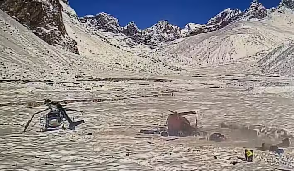

An Indian tourist was confirmed dead and a New Zealand citizen of Indian descent has been injured, following the collision of two helicopters on a helipad located in Nepal’s Solukhumbu district. According to the report, the incident took place around 8:15am local time at the heliport with Pheriche being one of the busiest points for helicopter rides which is said to be around 250 km in the northeastern direction of Kathmandu.
Rotor blades collide while landing aimultaneously
As per the Civil Aviation Authority of Nepal (CAAN), since both helicopters were heading towards the waypoint at the same time, their rotor blades ended up colliding.
Involved air operators: An aircraft operated by Fishtail Air was headed from Gorakshep, and Air Dynasty was heading to Pheriche from the town of Lukla where the accident took place.
Names of the victim: According to the Police, the identity of the deceased has been confirmed as 47-year-old Hazaribagh Kumar Vitur.
Reported injuries: Besides the male passenger that has been confirmed dead, two pilots were also injured during the deadly accident.
Footage of impact: CCTV footage captured at the Pheriche helipad showed the two aircraft operating in close proximity moments before their rotor blades interlocked, triggering immediate structural destruction.
DSP Nabinraj Budhathoki of the Solukhumbu District Police Office confirmed that local emergency teams responded to the site immediately following the impact.
Emergency rescue choppers airlifted the injured survivors to Mediciti Hospital in Kathmandu for specialized medical treatment, while the body of the deceased was transported to a regional facility in Lukla.
Investigation launched into Himalayan air safety
Civil Aviation Authority Information Officer Gyanendra Bhul confirmed that aviation safety inspectors have initiated a detailed investigation to review airspace control protocols and helipad congestion management at Pheriche.
Small helicopters are heavily utilized across Nepal’s mountainous terrain to ferry climbers, transport cargo supplies, and execute medical evacuations in areas inaccessible by road.