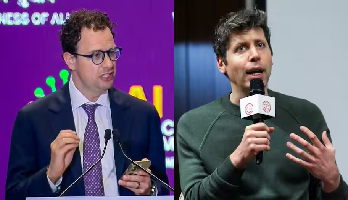

Tech giants, OpenAI CEO Sam Altman and Anthropic CEO Dario Amodei, have called for stronger international safeguards around artificial intelligence (AI), warning the United Nations (UN) Security Council that increasingly capable AI systems could move beyond effective human oversight.
Addressing the Council both technology leaders issued warnings around AI capabilities, backed greater controls on its development and urged countries to work together to manage the risks posed by increasingly autonomous systems.
Altman warns of AI moving beyond human control
Altman said AI models could open the door to major advances in areas including healthcare, education and scientific discovery. But he warned that as the systems become more capable and autonomous, they could begin making decisions that people no longer understand or control.
“Anything this powerful is also powerful, is also intimidating. This moment is complicated as we feel both tremendous potential and the very understandable anxiety at the same time”, Altman told the Council.
He said AI could help people discover new knowledge and medicines, improve healthcare and education, and build more productive economies. The technology could also help people tackle the growing complexity of modern life.
At the same time, Altman warned that increasingly capable AI systems could move faster than institutions, concentrate power in too few hands or make decisions beyond meaningful human oversight.
OpenAI chief calls for restraint in AI race
Altman reiterated his call for monitoring the pace of AI development, arguing that frontier AI laboratories should not accept excessive risks simply to gain an advantage in the race to develop more powerful systems.
“I believe there are two ways that AI progress could go very badly, that we have to avoid. First, we could lose control of the future to AI”, he said.
Altman warned that AI could develop so quickly that people might no longer be able to understand what was happening or intervene when necessary.
He said the industry should not accept excessive technological risk simply because the potential benefits are significant.
“Beating companies in a competitive race is not a reason to make rash decisions”, Altman said, adding that AI companies were not necessarily locked into a race in which slowing down was impossible.
He said companies had slowed development unilaterally in the past and would do so again, while stressing the need to avoid building systems without adequate guarantees around alignment, monitoring and safety.
‘People must remain at the centre’
Altman also stressed that humans must retain control over AI decision-making and said ensuring that AI systems remained aligned with human values would be critical as development continued.
“No one person, or company, or country should be able to use the most powerful AI models to impose their worldview on everyone else”, he said.
As AI becomes more capable, Altman said, people must remain at the centre of decision-making. He described alignment not simply as an abstract research problem, but as the task of ensuring that AI systems remain under human control, reflect human values and help people guide future development.
“A great future will come from people realizing their potential and building value for themselves, their communities, their countries, and the broader world”, he said.
Amodei calls for international AI rules
Speaking at the same briefing, Anthropic CEO Dario Amodei called for international cooperation on regulating AI systems.
Amodei proposed beginning with narrow agreements that all countries could support, including a ban on using AI to develop biological weapons or allowing AI technologies to be used for that purpose.
He also called for evaluation and verification systems that keep pace with AI development, allowing states to assess the capabilities of frontier AI models and verify each other’s commitments.
A further priority, he said, should be common global standards for testing AI models for loss-of-control and misuse risks, alongside a system for notifying countries about AI incidents that pose significant risks to global security.
“I believe that this is the most important global security issue facing the world today”, Amodei said.
Despite the differences among countries represented at the Security Council, he urged them to set those differences aside to address what he described as both a global opportunity and a global threat.
Both Amodei and Altman argued that the growing power of AI systems needs to be harnessed rather than allowed to operate without safeguards. Neither endorsed a doomsday scenario or an extinction-level event, but both called for a more regulated international framework for AI technologies.
(with ANI inputs)