
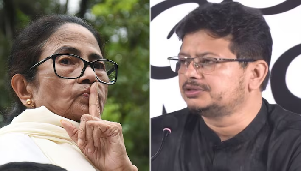

The Calcutta High Court set aside the appointment of rebel Trinamool Congress (TMC) leader Ritabrata Banerjee as Leader of the Opposition in the West Bengal Assembly and gave Speaker Rathindra Bose ten days to reconsider his decision. The ruling came on a day when rival TMC factions were due to appear before the Election Commission in New Delhi.
Justice Krishna Rao also set aside the appointment of Akhruzzaman as the Chief Whip of the Opposition. The single-judge bench stated that the Speaker’s order dated June 3, under which both these appointments were made, cannot be sustained in law.
The verdict follows a petition filed by senior TMC leader Sovandeb Chattopadhyay. Following the party’s defeat in the West Bengal Assembly elections earlier this year, Mamata Banerjee had selected Sovandeb Chattopadhyay for the position of Leader of the Opposition.
Why was Ritabrata Banerjee’s appointment challenged?
Sovandeb Chattopadhyay’s petition states that his name was approved during a party meeting held on May 6. Subsequently, on May 19, a proposal bearing the signatures of party MLAs was submitted to the Assembly Speaker.
However, Ritabrata Banerjee approached the Speaker and alleged that several signatures on the document were forged.
This dispute caused the party’s MLAs to split into two factions and ultimately, the majority threw their support behind Ritabrata.
After the Speaker accepted the nominations from the rebel faction, Chattopadhyay approached the High Court. Although the court initially declined to grant any immediate relief, it clarified that the future of these appointments would depend on the final verdict in the case.
How a split emerged within the TMC following the West Bengal Assembly elections
The dispute over leadership began after the BJP ended Mamata Banerjee’s 15-year rule in West Bengal in May. The TMC, which had won 215 Assembly seats in 2021, saw its tally shrink to 80 seats for the 2026 elections.
On June 3, a group of 58 TMC MLAs backed Ritabrata Banerjee for the position of Leader of the Opposition. Subsequently, the rebel faction elected senior MLA Arup Roy as their chairperson and established a separate organisational structure.
The rift extended to Parliament as well, where 20 out of the TMC’s 27 Lok Sabha MPs decided to break away from the party leadership.
The Election Commission heard both TMC factions regarding the party’s election symbol.
Both factions approached the Election Commission, laying claim to the name ‘Trinamool Congress’ and the party’s traditional election symbol, ‘two flowers on grass’. Representatives for Mamata Banerjee’s camp included Abhishek Banerjee, Kalyan Banerjee, and Derek O’Brien.
In September, the Election Commission temporarily barred both factions from using the party’s original name and election symbol during the Assembly by-elections.
Mamata Banerjee’s faction was assigned the name ‘Mamata All India Trinamool Congress’ and the election symbol of a ‘football player’.
Meanwhile, the other faction was allotted the name ‘Democratic Trinamool Congress’ and the ‘envelope’ as its election symbol. On September 28, the Supreme Court directed the Election Commission to resolve this dispute within three months. Since then, both factions have submitted documents to the Election Commission detailing the support they each command within the party.