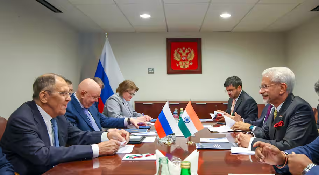

Russian Foreign Minister Sergey Lavrov has backed India’s candidacy for a permanent seat on the United Nations Security Council (UNSC), while cautioning against increasing Western representation as part of any reform of the powerful UN body.
Addressing world leaders at the UN General Assembly, Lavrov said changes to the Security Council must not weaken the prerogatives of the Council or its permanent members. He also made clear Moscow’s opposition to allocating additional permanent seats to Western countries.
Russia backs India and Brazil
“UN Security Council reform cannot involve any additional seats being allocated to Western countries, especially to Germany and Japan, who are now on the path to militarism and revanchism,” Lavrov stated.
At the same time, Lavrov called for broader representation of the Global South, arguing that the Council’s composition should better reflect geographical realities.
“We are in favour of broadening the representation of Asia, Africa, and Latin America. We support Brazil’s and India’s candidatures for a permanent seat,” Lavrov said.
He added, “And at the same time, I wish to emphasise this, we must satisfy the interests of the African continent in keeping with the Israeli consensus and the SEAT declaration.”
BRICS nations, including Russia, had earlier reiterated their support for Brazil and India playing a greater role in the UN, including the Security Council, in the New Delhi declaration.
Mauritius endorses India’s candidature
The push for Security Council reform was also prominent during the ongoing general debate at the UN headquarters, with several leaders calling for the Council to reflect present-day geopolitical and economic realities.
Mauritius gave an explicit endorsement of India’s bid. Mauritian Foreign Minister Dhananjay Ramful said, “We support the positions of the G4 and of L69 on Council reform, and we reiterate our support for India’s candidature for a permanent seat, commensurate with its constructive role in global affairs.”
Mauritius also endorsed the Common African Position, calling for adequate regional representation, equal rights for new permanent members and dedicated spaces for small island developing states.
Portugal also backed structural reform. Prime Minister Luis Montenegro called for a more representative Security Council with permanent representation for Africa, Brazil and India.
G4 partners press for reform
Support for New Delhi’s ambitions also came through the four-nation G4 alliance. Marshall Islands President Hilda Heine said, “The Marshall Islands affirms its longstanding support for Japan and its G4 partners to achieve permanent membership on the UN Security Council.”
Japanese Prime Minister Sanae Takaichi did not name individual G4 candidates in her address, but placed Security Council reform at the centre of her remarks.
“We need to transform it without delay into a structure that truly reflects the current realities of the international community,” Takaichi said.
She also backed expansion in both the permanent and non-permanent categories, citing broad consensus among member states.
Calls grow for regional representation
Other leaders pressed for greater regional parity without naming specific candidates.
Finnish President Alexander Stubb supported permanent seats for Africa, the Asia-Pacific and Latin America while opposing a concentration of veto power. Saint Lucian Prime Minister Philip J. Pierre called for an immediate conclusion to the long-running reform negotiations.
“The prolonged reform process must be concluded quickly to include expanded permanent and non-permanent membership for Africa, the Asia-Pacific, and Latin America and the Caribbean regions,” Pierre said.
African leaders also highlighted what they described as the historical imbalance in the Security Council’s composition.
Sierra Leone President Julius Maada Bio said the institution still reflected the geopolitical order of 1945.
“The Security Council still reflects the world of 1945. Africa, home to more than 1.6 billion people and the subject of much of the Council’s work, still has no Permanent Seat,” Bio said.
Ghanaian President John Dramani Mahama similarly called reform essential to the UN’s future.
“Security Council reform is not a favour to Africa; it is an imperative for the legitimacy, credibility, and survival of the United Nations,” Mahama said.
India’s case for a permanent seat
While there is broad support for modernising the Security Council, divisions remain over individual candidatures, regional allocations and the veto system.
These differences have left formal negotiations deadlocked.
India, which is part of the G4 alongside Brazil, Germany and Japan, continues to base its case on its large population, rapid economic growth, extensive contribution to UN peacekeeping and its position as a major voice for the Global South.
The Security Council currently has five permanent members: China, France, Russia, the United Kingdom and the United States, which hold veto power, alongside 10 non-permanent members serving two-year terms.
Any structural change requires a two-thirds majority in the General Assembly, ratification by two-thirds of the wider UN membership and the explicit concurrence of all five permanent members.
(with ANI inputs)