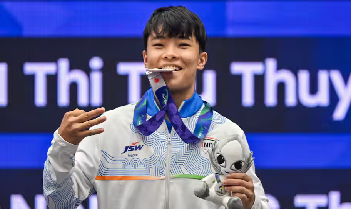

Roshibina Devi wrote a new chapter in Indian wushu after winning silver in the women’s 60kg sanda event at the Asian Games 2026 in Aichi-Nagoya on Thursday. Roshibina became the first Indian – man or woman – to win wushu medals across three consecutive Asian Games editions.
The 25-year-old Indian lost the final 0-2 to China’s Zhang Xiaoyu at the Aichi Prefectural Martial Arts Hall. Zhang took both two-minute rounds 5-0, with all five judges scoring the bouts in her favour. The gold stayed with China; the history belonged to Roshibina.
Three Games, Three Medals
With this performance, Roshibina has completed a rare continental medal hat-trick:
Jakarta-Palembang 2018: Bronze (Women’s Sanda 60kg)
Hangzhou 2022 (held in 2023): Silver (Women’s Sanda 60kg)
Aichi-Nagoya 2026: Silver (Women’s Sanda 60kg)
Before Roshibina’s achievement, no Indian wushu practitioner – male or female – had ever medaled at three straight Asiads.
Indian stalwarts such as M. Bimoljit Singh (2006, 2010) and Narender Grewal (2014, 2018) had managed two, but Roshibina’s consistency across nearly a decade sets a new benchmark in Indian martial arts history.
Overcoming Turbulence To Reach Podium
Roshibina’s journey to the 2026 podium was marked by intense hurdles before she even landed in Japan. Having dealt with a severe knee injury over the previous year, she initially missed selection after falling short in the national trials.
However, following a serious ACL injury sustained by squad-selectee Divyanshi Choudhary, the Wushu Association of India (WAI) named Roshibina as the official medical replacement.
Arriving with limited preparation time and directly from Manipur, Roshibina tuned out the off-mat noise and let her combat pedigree take over. She began her campaign with decisive victories, dominating Bangladesh’s Shika Khatun in the pre-quarterfinals before dismantling Macao’s Chu Man Sin 5-0 in the quarterfinals to guarantee a medal.
In the semifinals, she outclassed Indonesia’s Thania Kusumaningtyas 2-0 to advance to the gold-medal bout. While China’s Zhang proved formidable in the final to take the gold 2-0, Roshibina’s silver finish reaffirmed her position at the top tier of international wushu.
From Bishnupur To Asian Record Books
Hailing from Kwasiphai Mayai Leikai in Manipur’s Bishnupur district, Roshibina’s rise reflects grit and personal sacrifice.
In her early years, her father, a farmer, sold family land to finance her training and gear. That investment bore fruit on the world stage, starting from her bronze at the 2016 World Junior Championships to the Arjuna Award, and now to three consecutive Asian Games podiums.
The 2026 silver has only strengthened Roshibina’s desire to change its colour in the future.
“I am very happy to win the Wushu medal for the third time for India. I will prepare for more games in the future and look to change the colour of the medal,” Roshibina said after her silver-medal finish.