
Aishwaria Sonavane
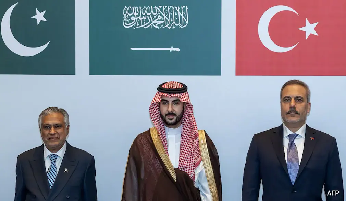
The timing of the Makkah Joint Defence Agreement (MJDA) signed between Pakistan, Saudi Arabia, and Turkey in August was hard to ignore. It came into existence when the war in West Asia involving Iran raised apparent scepticism towards the reliability of American security assurances in the Gulf region. The language of the agreement seemed deliberately broad-based, with the most striking clause stating that an armed attack against one member would be regarded as an attack on all. The stated purpose was to strengthen collective deterrence.
The act, established on a political commitment and defence cooperation framework, still lacks a robust institutional foundation and has no operational experience. The misaligned threat perceptions of Islamabad, Riyadh, and Ankara lend more credence to the pact’s ambiguity.
The MJDA now faces its first test.
Following the sustained Yemeni Houthi-led attacks on Saudi Arabia’s cities, ports, and energy facilities, on October 5, the defence and foreign ministers of MJDA member states met in Riyadh for an emergency session of the Strategic Political and Defence Committee (SPDC) under the pact. The states agreed to move to a practical implementation of the defence commitments to ensure rapid deployment of agreed forces and capabilities in the Kingdom, “in accordance with the national legislation of the parties”. The Foreign Office described this as the first invocation of the bloc since its signing.
In Action Mode
The agreement was signed in August. Since then, the three governments have been establishing institutions, appointing mechanisms, holding meetings between defence officials and military chiefs, discussing intelligence cooperation, and reportedly working towards integration of capabilities. The September meeting of military chiefs and the October meeting of the SPDC show that the institutional groundwork is being done. In that context, to view the pact as merely symbolic or to label it an ‘Islamic NATO’ understates or overstates its current reality. Instead, the recent announcement indicates the alliance is rapidly acquiring operational meaning. The timelines are trying to keep up with the hostilities around it.
For Pakistan, the challenge will remain in how delicately it can honour the pact – which could include protecting the Kingdom but not directly targeting Yemen. Islamabad’s West Asia pull comes at a time when it is fighting its own war on the border with Afghanistan, managing a long frontier with Iran, mediating an ongoing conflict, and carrying a domestic Shia constituency that will have low appetite for actions perceived to be anti-Tehran.
The pact was signed at a time when the Gulf was highly vulnerable to regional conflicts. Driven by its longstanding patron-client relationship with Saudi Arabia and a robust defence partnership with Turkey, Islamabad committed to the agreement without anticipating how quickly it would be drawn into a regional war.
In that light, the credibility of this pact will increasingly rely on what Pakistan and Turkey are able to put behind the commitment. In the past, Pakistan’s parliament unanimously opposed sending troops to fight the Iran-backed Houthis on the Kingdom’s behalf in 2015. Since Pakistan’s realities remain largely unchanged, it will likely remain a defensive posture. The nature of this defence would mean air defence, intelligence, surveillance, logistics, technical assistance, protection of critical infrastructure, maritime security, or deployment of forces to protect the Kingdom’s territory. Offensive operations against the Houthis will possibly remain outside the scope of this pact. This balancing act for Pakistan will hopefully mean honouring a commitment with its patron, Riyadh, while containing Iran-related sectarian and border tensions at home.
Pak’s Very Visible Limitations
The distinction is also visible in Pakistan’s actions. It has deployed forces and air assets to Saudi Arabia in a defensive position, while playing a mediation role in the Iran-US conflict. For Pakistan, the limited involvement will reduce the risk of entrapment in far-away conflicts while also defining the potential limits of collective defence under this pact for its adversaries. The uncertainty can itself carry some deterrent value. However, deterrence becomes a challenge when the nature and scope of attacks keep evolving.
Interestingly, Pakistan’s ongoing conflict with bordering Afghanistan has not invoked the pact, with no indication of Islamabad seeking Ankara’s or Riyadh’s assistance in this confrontation. This inaction or lack of acknowledgement is also revealing of how the security threats against Pakistan, despite the varying intensity, are potentially not given the same weight as those involving Saudi Arabia. Therefore, the ambiguity that allows Pakistan room to manoeuvre in Yemen similarly extends the protection to Ankara and Riyadh from entering Pakistan’s conflicts.
For now, the more political attention, resources, and diplomatic bandwidth Islamabad commits to West Asia, the less capacity it has to focus on India. While this offers New Delhi a temporary reprieve as its primary rival navigates the middle ground between abandonment and entrapment in West Asia, it should not be mistaken for a permanent strategic advantage. In the near term, New Delhi must closely watch two key aspects – Saudi Arabia’s financial flows and oil credits, which could ease Pakistan’s economic stress, and Islamabad’s deepening defence-industrial ties with Ankara.