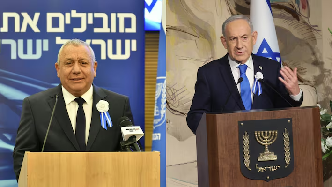

Yashar party chairman Gadi Eisenkot has directed his negotiating team to invite representatives of Benjamin Netanyahu’s Likud party for intensive coalition discussions, with the first meeting scheduled for Sunday, in a renewed attempt to form a broad-based government in Israel.
In a statement, Yashar described the move as a sincere effort to establish the widest possible government, saying it would explore all available options and pursue bold initiatives to break the deadlock in negotiations, The Times of Israel reported.
Previous talks ended without progress
The two parties held an initial round of discussions last Sunday but failed to make headway. They subsequently traded accusations over their willingness to form a unity government.
Likud has called on Eisenkot’s bloc to suspend its legislative agenda and end cooperation with Arab parties. Eisenkot, however, has ruled out a power-sharing arrangement with Netanyahu, insisting that he would be the sole prime minister in any unity government involving Likud, according to The Times of Israel.
Differences emerge over potential coalition partners
The coalition-building effort has also exposed differences within Eisenkot’s bloc over possible partners.
Democrats chairman Yair Golan has indicated that he would not oppose the formation of a coalition government involving ultra-Orthodox parties. However, he has ruled out joining what he described as a “fake unity government” that would allow Netanyahu to remain in power, The Times of Israel reported.
Eisenkot faces 61-seat majority challenge
Israeli President Isaac Herzog formally tasked Eisenkot with forming the country’s next government on November 8. He was given an initial 28-day period, with a possible 14-day extension, to secure the support of at least 61 lawmakers in the 120-member Knesset.
The election results underline the challenge facing the Yashar leader, with neither political bloc securing the numbers needed to form a government.
In the October 27 election, Netanyahu’s right-wing and ultra-Orthodox alliance won 53 seats. This included 27 for Likud, seven each for Otzma Yehudit and United Torah Judaism, six for Shas, and six for Religious Zionism-Zehut.
Eisenkot’s four-party Zionist bloc secured 48 seats, comprising 21 for Yashar, 12 for B’Yachad, eight for the Democrats and seven for Yisrael Beytenu.
The two Arab-majority parties, the Joint List and Ra’am, won 11 and eight seats, respectively. Both backed Kahana’s 66-52 speakership vote, but key figures within Eisenkot’s bloc have ruled out formal coalition arrangements with them.
With neither bloc holding a parliamentary majority and cooperation with Arab parties facing resistance within Eisenkot’s camp, the renewed negotiations with Likud could prove crucial to determining Israel’s next government.
(with ANI inputs)