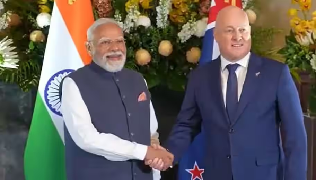

New Zealand’s Parliament on Wednesday passed legislation to implement the country’s free trade agreement (FTA) with India, under which tariffs on about 95% of New Zealand exports to India will be eliminated or significantly reduced.
The legislation was passed by a vote of 93–29, with support from the opposition Labour Party.
Under the agreement, over half of all the products will become duty-free from the day it takes effect.
“For exporters, the benefits are immediate and substantial,” New Zealand Trade Minister Todd McClay said in a statement.
McClay further said, “We expect this high-quality agreement to enter into force this year, delivering on our promise to complete a free trade agreement with India this term.”
Under the agreement, all Indian products will gain duty-free access to the New Zealand market, while Wellington has also committed to investing $20 billion in India over the next 15 years.
India-New Zealand FTA
India and New Zealand originally signed the trade agreement in April, marking a significant step in strengthening bilateral economic ties.
The deal was being described as one of India’s fastest concluded bilateral trade deals.
The FTA negotiations began in March 2025 and concluded in December 2025. The agreement was being described as one of India’s fastest trade deals, taking just nine months to progress from the start of negotiations to signing.
The agreement comes after earlier negotiations stalled following several rounds of talks, mainly due to concerns over India’s dairy sector. The renewed agreement takes a more balanced approach, addressing market access while also taking into account sensitive sectors.
India-New Zealand bilateral trade
Two-way trade between the two countries totalled $2.29 billion in the year to June 2026, with India ranking as New Zealand’s ninth-largest goods and services export market.
Bilateral merchandise trade between India and New Zealand has fluctuated in recent years, with both Indian exports and imports recording periodic increases. Trade in services has also gained momentum. India’s services exports to New Zealand rose by about 13 per cent to $634 million in 2024, while services imports increased by around 7 per cent to $611 million.
India’s key exports to New Zealand include pharmaceuticals, machinery, textiles and precious stones. Imports from New Zealand mainly comprise wool, metals, fruits, nuts and aluminium.
India is expected to benefit from New Zealand’s immediate elimination of tariffs on a large number of product lines. At present, duties of around 10 per cent are imposed on several Indian exports, including textiles, leather goods, carpets, ceramics and automotive components. Removing these tariffs is expected to improve the competitiveness of Indian products in the New Zealand market.
Agricultural exports such as tea, coffee and spices are also expected to gain better market access.
Dairy products excluded from agreement
Dairy products, including milk, cheese, butter and yoghurt, have been excluded from the agreement due to India’s domestic sensitivities. Several other categories, including certain animal products, sugar, oils, gems and jewellery, and some metals, have also been kept outside the agreement.
The trade agreement will come into effect after both countries complete their respective ratification procedures.