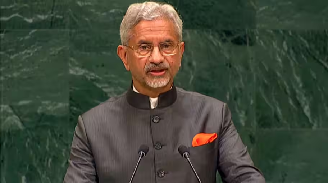

External Affairs Minister S. Jaishankar used India’s address to the UN General Assembly to call for peace, defend India’s right to act against terrorism and press for a greater voice for developing countries in global decision-making. In a wide-ranging speech, Jaishankar touched on terrorism, the conflicts in Ukraine and the Gulf, food and energy security, artificial intelligence, development and the need to reform international institutions.
His strongest warning was directed at an unnamed country, which he described as a “serial practitioner of terrorism”. Jaishankar accused it of misrepresenting facts before the General Assembly and attempting to normalise terrorism and avoid accountability.
“Yesterday, a serial practitioner of terrorism misrepresented facts before this assembly,” Jaishankar told the General Debate. “Our right to defend ourselves against terrorism will be exercised.”
He did not identify the country or spell out what action India might take. He said state-sponsored terrorism with a cross-border purpose was a direct challenge to the international order and called for governments involved in such activities to be held accountable.
“Friendship and goodwill cannot coexist with terrorism,” he said, while calling for continued zero tolerance towards terrorism and action against terror financing.
India calls for restraint in Gulf, Ukraine
Jaishankar also urged an end to hostilities in the Gulf and Ukraine, warning that conflicts were affecting countries far beyond the immediate battlefield.
“We remain deeply concerned over continuing hostilities,” he said, stressing the need to protect seafarers and keep energy and foodgrain supplies moving.
On the Gulf, he called on all sides to exercise restraint and de-escalate tensions.
“India calls upon all parties to exercise restraint, de-escalate tensions, ensure protection of civilians, and uninterrupted flow of energy and commerce,” he said.
On Ukraine, Jaishankar said India supported ongoing efforts to bring peace and recalled Prime Minister Narendra Modi’s message to Russian President Vladimir Putin – “As Prime Minister Narendra Modi stated, endless war must give way now to an end to war.”
India also reiterated its support for a two-state solution in West Asia, with Israel and Palestine living side by side as sovereign states. Jaishankar said India was providing humanitarian assistance to Palestinians.
He also raised concerns over attacks on commercial vessels and seafarers in waters stretching from the Gulf and Red Sea to the Black Sea, noting that Indian seafarers had lost their lives.
‘4F crisis’ puts Global South under pressure
Jaishankar said developing countries were facing an overlapping crisis involving food, fuel, fertiliser and finance, which he described as the Global South’s “4F crisis”.
“The predicament of the global South is particularly acute,” he said. “It faces a 4F crisis of the security of food, fuel, fertiliser, and finance.”
He pointed to a super El Niño, fertiliser shortages and disruptions to grain movements as major concerns. Restricted market access and what he called non-market practices were also making it harder for developing countries to industrialise.
The wider global economy, he said, was being affected by the “weaponisation of everything”, including finance, supply chains, technology and market access. Countries were responding by reducing risks and diversifying their economic relationships, but this was also contributing to a loss of trust.
The impact of conflicts on developing countries was a recurring theme during the General Debate.
Dominican Republic President Luis Abinader said wars in Europe and the Middle East, although “far away from our coasts”, were affecting domestic food and energy prices.
Comoros President Azali Assoumani warned that the conflict in the Middle East and disruption around the Strait of Hormuz were threatening food and energy security in import-dependent countries.
Maldives Vice President Hussain Mohamed Latheef said disruptions to maritime traffic were affecting fuel prices, food supplies, air travel, tourism and public finances.
Latvian President Edgars Rinkēvičs summed up the wider concern by saying: “What happens in Ukraine does not stay in Ukraine; what happens in the Middle East, in the Red Sea, and in Sudan does not stay there.”
India presents development record
Against this backdrop, Jaishankar presented India as both a developing country and a partner for the wider Global South.
He said improvements in healthcare, nutrition, education, drinking water, electricity, roads and housing had improved the prospects of “one-sixth of humanity”. He also highlighted India’s digital public infrastructure and said the country was sharing its experience with other nations.
India, he said, had undertaken 600 major development projects in 78 countries, covering infrastructure, manufacturing, agriculture, information technology and capacity building. African countries and small island developing states had been among India’s preferred partners.
“Even as India progresses, we are conscious of our global responsibilities,” Jaishankar said. “We know that many of our experiences and achievements are replicable elsewhere.”
He also cited India’s climate initiatives, including the International Solar Alliance, the Coalition for Disaster Resilient Infrastructure and the Global Biofuels Alliance.
India had supplied medical assistance to conflict zones and countries affected by epidemics and natural disasters, he said, citing its response to flash floods in Nepal and an earthquake in Venezuela.
India backs national AI models
Artificial intelligence was another major theme of Jaishankar’s address, with India arguing that countries should have the freedom to develop their own AI models and deployment strategies according to national priorities.
Jaishankar said AI could drive economic and social progress but warned that its misuse could sharpen existing biases and weaken mutual respect.
India intends to make AI part of its partnerships with the Global South, he said.
The issue was also raised by several other countries during the General Debate. Malaysia’s Foreign Minister Mohamad Haji Hasan warned that developing countries should not merely become hosts for data centres while decisions about AI are made elsewhere.
“The Global South cannot simply become a destination for data centres while decisions about AI are made elsewhere,” Hasan said, calling for developing nations to become “partners in innovation, not merely customers and markets”.
German Foreign Minister Johann Wadephul pointed to the concentration of AI patents among companies in a small number of countries and said: “Whenever power becomes global, responsibility must become global, too.”
Belize Prime Minister John Briceño similarly warned that poorly governed AI could deepen inequality and leave developing countries dependent on technologies and rules designed elsewhere.
The UN adopted the Global Digital Compact in 2024 as part of efforts to strengthen international cooperation on digital technologies and AI. Discussions on how to translate those principles into international rules are continuing.
India renews call for multilateral reform
Jaishankar also used the address to renew India’s call for changes to international institutions as the global balance of power becomes more multipolar.
“The post-1945 order is giving way to new realities,” he said, arguing that broader consultation and more transparent decision-making were needed.
“Large sections of humanity cannot be excluded from that process,” he added. “The case for reformed multilateralism only gets stronger day after day.”
India has long sought reform of the UN Security Council, including a permanent seat for itself, arguing that the council’s present structure reflects the geopolitical settlement that followed the Second World War.
Jaishankar ended his address with a reference to Mahatma Gandhi: “There is no way to peace. Peace is the way.”
His speech brought together India’s security concerns, its calls for an end to ongoing conflicts and its wider argument that developing countries should have a greater role in shaping the rules governing global finance, technology, trade and international institutions.
(With IANS inputs)