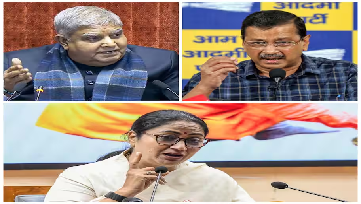

Delhi’s voter-roll revision has put the names of Chief Minister Rekha Gupta and former Chief Minister Arvind Kejriwal in the same verification list as several other well-known names, including former Vice President Jagdeep Dhankhar, former Supreme Court judge Justice Madan B Lokur and New Delhi MP Bansuri Swaraj.
The Delhi Chief Electoral Officer’s office has published details of 33.1 lakh electors whose entries have been flagged during the Special Intensive Revision (SIR). Their names have been marked for verification because of either “logical discrepancies” in the voter records or because the entries could not be mapped to the previous SIR roll. The notices do not by themselves mean that the electors have been removed from the voter list.
The draft electoral roll published on August 31 contains 97,53,577 electors. The number is down from 1,45,10,299 electors on the rolls as of June 30. The verification process will determine which of the flagged entries are included in the final roll, scheduled to be published on November 4.
CM’s entry cleared after verification
Gupta’s name was flagged in Part Number 123 of the Shalimar Bagh Assembly constituency because the Election Commission’s software identified an “age gap of less than 15 years between a parent and progeny”.
The matter was dealt with through physical verification. An electoral registration officer said a Booth Level Officer (BLO) visited Gupta’s address and checked the documents submitted by her.
“Following verification of the facts and documents submitted by the chief minister, her electoral entry has been validated and parked for inclusion in the final electoral roll of AC-14 (Shalimar Bagh), scheduled to be published on November 4,” the officer said.
The case shows how an entry can move from the flagged list to validation after the required documents and details are checked.
Kejriwal, family listed under ‘no mapping’
Former Delhi Chief Minister Arvind Kejriwal has been listed under the “no mapping” category along with his wife Sunita Kejriwal, parents Gobind Ram Kejriwal and Gita Devi and son Pulkit Kejriwal.
The category covers voters whose details, or those of a close relative, could not be matched with the electoral roll from the previous SIR exercise.
The Aam Aadmi Party (AAP) chief and the four members of his family are part of a group of 110 voters in a section of the New Delhi Assembly constituency who received notices under the exercise. The election authorities have asked such electors to establish their eligibility through the prescribed verification process.
The “no mapping” category also includes Dhankhar and his wife Sudesh Dhankhar, former Union Minister Kapil Sibal and his wife Promila Sibal, former Union Minister Subramanian Swamy, historian Romila Thapar and Bansuri Swaraj.
Congress leader Abhishek Manu Singhvi also figures in the list, although the reason for his entry being flagged was left blank in the published details.
Several types of discrepancies checked
The Election Commission (EC) has identified 11 categories of discrepancies for the Delhi SIR exercise. These include mismatches between names in the existing and previous rolls, unusual age differences between voters and their parents or grandparents, cases where multiple children are listed under the same parent and differences in the father’s name or the relative used for mapping.
Around 19.3 lakh electors have been flagged under the “logical discrepancies” category, according to the details released as part of the exercise.
Delhi Minister Parvesh Sahib Singh’s name was flagged for a “self-name mismatch”, meaning a difference between the name entered during the present SIR and the previous electoral roll. Former Delhi BJP President Virendra Kumar Sachdeva was also listed under the same category.
Justice Madan B Lokur’s entry was flagged because the system found that the age difference between him and his grandfather did not meet the specified requirement. He is registered as a voter in Malviya Nagar.
The election authorities have said that prominent political leaders and other well-known people listed for verification will not necessarily have to appear personally at hearing centres. Electoral registration officers can identify such cases and ask BLOs to visit their registered addresses for verification.
Final roll due on November 4
The 33.1 lakh electors listed for verification account for roughly one-third of the 97.5 lakh voters in the draft electoral roll. The process is now moving towards disposal of these cases, with verification and decisions scheduled to be completed by October 29.
The SIR process has also become a matter before the Supreme Court. A petition challenging the exercise in Delhi is scheduled for hearing, with the challenge covering aspects of the method used to identify voters for verification.
For voters placed in the “no mapping” category, the EC has prescribed a set of documents for establishing eligibility. The verification process will determine whether the entries are carried forward to the final electoral roll.
The Delhi CEO’s office is expected to continue processing claims, objections and verification reports through October before publishing the final list on November 4.