
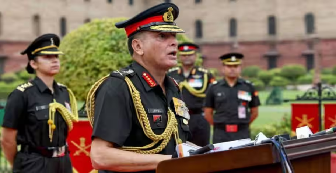

Technology is changing the way wars are fought. Addressing a defence summit in the national capital, Chief of Army Staff General Dhiraj Seth said the soldier on the ground still decides control of territory. He said control of land continues to be the most important measure of military success.
General Seth said modern technology can make individual battles shorter, with drones, precision weapons, sensors, networks and other systems changing the speed and scale of combat. The length of a war can tell a different story. He described today’s conflicts as “wars with pause”, where periods of intense fighting can be followed by breaks before hostilities rise again.
He said land continues to be the “one and only tangible and useful factor of success” and that military victory is measured in territorial terms.
He described such pauses as part of military strategy. They can change the intensity and form of a conflict. He said the Army is preparing for warfare that can stretch across several domains, including land, air, cyber and information operations.
When Seth took charge as Army chief in June, he set out a five-point VIJAY plan built around vigilance, innovation and transformation, jointness and integration, Atmanirbharta and Yodha First.
Why land still counts
General Seth said the rise of technology and information warfare does not change the basic requirement of controlling territory.
“Land will always be the one and only tangible and useful factor of success. Victory was, is and will always be measured in territorial terms, and that territory will be occupied, secured and defended only by the force,” he said.
He also referred to the role of soldiers who physically operate on the battlefield. He said every new military capability should show how it directly helps the soldier who puts his boots or tracks on the ground.
That view also fits with the Army chief’s stated priority of “Yodha First”. When he took charge, he said the approach would cover Army personnel from Agniveers to veterans and Veer Naris. Training, technology adoption and welfare would form part of the plan.
The reference to territorial control also recalls the way military victories have traditionally been assessed. The 1971 war, for instance, gave India one of its most memorable images on December 16, when Pakistani troops surrendered. Seth referred to that image as an example of how battlefield outcomes and control of territory determine how a war is remembered.
Technology is only the beginning
Seth said having access to advanced technology does not automatically provide a lasting military advantage. A technology available to India can also become available to an adversary.
“The technology we have can also be available to our enemy. Having the technology is only the beginning,” he said, emphasising that the real advantage comes from the ability to develop new capabilities fast, adapt them to changing conditions and find ways to counter an opponent’s methods.
The Army chief has made technology and modernisation a major part of his agenda since taking charge. His VIJAY roadmap calls for a force that can operate across multiple domains and adapt its doctrine and technology as the nature of warfare changes.
Seth also said future warfare will not necessarily require every existing weapon system to be discarded in favour of entirely new platforms. Older systems can gain new capabilities through artificial intelligence, sensors, networking and other technologies.
That approach can allow existing military assets to perform new roles and work with newer systems. It also places greater importance on upgrading equipment with speed as battlefield requirements change.
Self-reliance for long wars
Another major part of Seth’s address was defence self-reliance. He said Atmanirbharta has to go beyond manufacturing weapons in India. The country needs the ability to design, develop, manufacture, sustain and upgrade military systems within the country.
“Aatmanirbharta must mean design in India, develop in India, manufacture in India, sustain in India, upgrade in India and also make for the world,” he said.
He stated a country involved in a prolonged conflict needs to be able to sustain its military without being restricted by the availability of supplies from other countries. That requires domestic capacity across the entire life cycle of a defence system.
He also warned against a different problem in indigenous production – technology becoming outdated by the time a system is ready for use.
“The challenge is not just to reduce dependencies on others but also to ensure that what we develop indigenously does not become outdated by the time it is dumped,” he said.
He described this as “indigenous obsolescence” and said the possibility of such a trap needs to be addressed as India develops its own defence capabilities.
India’s defence manufacturing policy has placed emphasis on domestic design, production and exports. Seth had earlier said that the Army’s aim was to “win our wars with indigenous solutions”, making self-reliance one of the five pillars of his VIJAY roadmap.
The Army chief’s latest comments came days after his official visit to Russia, where he held talks with senior military officials and visited defence institutions. According to the Ministry of Defence, the September 16-18 visit included talks on military cooperation, training and contemporary military developments.