
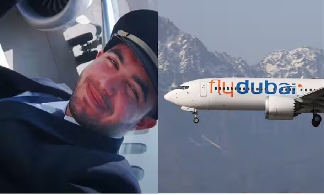

Soon after, the identity of the Omani co-pilot accused of attacking Indian pilot Captain Smit Machchhar aboard a Flydubai flight bound for Tel Aviv was disclosed. Several revelations have come out that he had previously been moved away from flying duties at Oman Air after government surveillance reportedly detected his visits to radical websites.
Hamam al-Hammami underwent pilot training with Oman Air but was subsequently assigned an office role after the surveillance findings emerged. One source told CBS News that he resigned following the transfer and left the airline around 2024.
Al-Hammami had also previously been barred from flying in Oman over concerns about his alleged extremist views, reportedly influenced by an earlier stay in Syria, Al Arabiya English reported on Friday, citing sources.
Alleged links to al-Qaeda figures
Sources cited in the reports said that, at one point, al-Hammami shared a video featuring aircraft belonging to Israeli airline El Al in Dubai.
The clip reportedly ended with a photograph of Ayman al-Zawahiri, the former al-Qaeda leader killed in a US drone strike in 2022.
After moving to Dubai, al-Hammami joined Flydubai without undergoing formal background vetting through the Omani government, sources told CBS News.
Although he holds Omani citizenship, sources said al-Hammami was not born in Oman and had spent most of his life abroad. His mother is reportedly of Syrian origin, while his father is Omani. The Omani government has not publicly verified his nationality.
LinkedIn posts raise fresh questions
CNN reported, citing sources and an Israeli official, that a LinkedIn profile belonging to al-Hammami featured two posts published on Wednesday, around nine hours after the September 30 incident.
The posts contained cockpit footage of an El Al aircraft and images of al-Qaeda figures.
A source told CNN that al-Hammami had previously worked for Royal Air Maroc, Morocco’s national carrier. An Israeli official separately confirmed to the network that he had been employed by Flydubai for eight months before the incident.
The LinkedIn account, under the name Hamam al-Hammami, listed seven years of service with Oman Air, ending in February 2025.
It also showed a subsequent stint with Royal Air Maroc from June 2025 to January 2026, but made no mention of Flydubai. One source verified that the profile belonged to the pilot involved in Wednesday’s incident.
Both posts appeared consecutively on Wednesday, roughly nine hours after the emergency unfolded. CNN said it remained unclear whether al-Hammami authored the posts or whether they were scheduled in advance.
The first post featured video clips recorded inside the cockpit of a Boeing 737 Max aircraft. The Flydubai plane involved in Wednesday’s diversion was a similar Boeing 737 Max 8.
One clip, which CNN geolocated to Dubai International Airport, showed the camera operator zooming in on an El Al aircraft. The cockpit display showed flight number OMA624 and the date October 11, 2023, matching a regular service between Dubai and Muscat.
The video ended with photographs of Ayman al-Zawahiri, who succeeded Osama bin Laden as al-Qaeda leader, and Humam Khalil Abu-Mulal al-Balawi, an al-Qaeda loyalist responsible for a 2009 suicide bombing that killed nine people, including seven American CIA officers and contractors.
The second post featured an artificial intelligence-generated graphic depicting Islam’s three holiest locations, Mecca, Medina and Jerusalem, connected by an illuminated path.
According to CNN, the image was accompanied by a forceful poem recited in the background, with themes of defiance, fearlessness in the face of death and the defence of dignity.
Al-Hammami’s LinkedIn profile also stated that he had studied at Buckinghamshire New University in England.
Probe into cockpit assault
The security incident took place on September 30 aboard a Flydubai flight travelling from Dubai to Tel Aviv. Authorities are investigating whether al-Hammami’s alleged assault on Captain Machchhar inside the cockpit was a deliberate act of terror intended to crash the aircraft.
The confrontation sent the plane plunging around 16,000 feet in just two minutes, prompting an emergency hijacking alert.
Despite suffering serious injuries, Captain Machchhar fought back and managed to unlock the cockpit door.
Cabin crew members and passengers then rushed in and overpowered al-Hammami, allowing the flight crew to regain control and stabilise the aircraft.
Two off-duty pilots also stepped in to help manage the plane before it made an unscheduled emergency landing in Tabuk, Saudi Arabia. All 180 people aboard the aircraft disembarked safely.
(with ANI inputs)