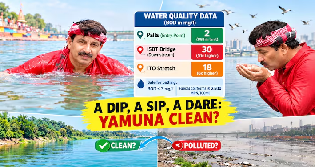

BJP MP Manoj Tiwari undertook a ritual dip at Sonia Vihar ghat, claiming that the water was significantly purified and safe for the Chhath Puja. A Northeast Delhi legislator said pollution levels have reduced to half in the last 18 months, citing the migration of birds in the area as evidence of ecological improvement.
Dares of political parties and the counter challenge of the AAP
The BJP member complimented the current government for the efforts taken to clean the river and said that in two years, as much as has been done as what could be achieved over several decades in other regimes.
Accusations in politics: He accused previous AAP governments for blaming the upstream states such as Haryana for pollution in the river when they were not able to make drainage arrangements.
AAP response: Delhi AAP president Saurabh Bharadwaj refuted his allegations and said that the upstream region from Palla to Wazirabad is known to have lesser pollution.
Challenge of the AAP: He challenged Tiwari and Delhi Water Minister Parvesh Verma to drink water or take a dip in downstream at Kalindi Kunj near Okhla barrage.
Fact-Check: What do the official pollution data tell us?
Contrary to political assertions about a new face of the river, the water quality analysis for the 52 kilometers of Delhi’s Yamuna stretch reveals variations in water parameters between the upstream and the highly urbanized downstream.
The water bathing standard prescribes that the Biochemical Oxygen Demand (BOD) should be 3 mg/l or below along with faecal coliforms up to 2,500 MPN per 100 milliliters.
Palla (entry point): The biochemical oxygen demand is 2 mg/l, which keeps it within the limit safe enough for bathing purposes.
ISBT bridge (downstream): Biochemical Oxygen Demand is 30 mg/l, ten times higher than the safety limit, and the faecal coliforms are 35,000 MPN per 100 ml (14 times the desired limit).
ITO stretch: The biochemical oxygen demand dropped from 70 mg/l in July 2025 to 18 mg/l in September 2026 (six times above permissible limit).
River rejuvenation roadmap target for May 2029
Union Home Minister Amit Shah launched 43 river rejuvenation projects worth Rs 8,941 crore to restore the Delhi stretch of the river by May 2029.
According to the Delhi Water Minister Parvesh Verma, while Palla to Wazirabad stretches have shown some improvement, the Wazirabad to Kalindi Kunj stretches need further two to three years of engineering work.