
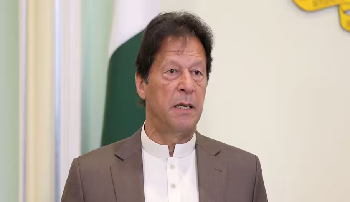

Imran Khan is in prison, and his party has now lost the only provincial government it controlled in Pakistan. As his supporters fight Islamabad’s takeover of Khyber Pakhtunkhwa, opposition leader Mahmood Khan Achakzai has alleged that Khan is being pressed to accept an exile-style deal. The claim comes before a court hearing on whether the takeover itself was lawful.
Opposition leader Achakzai made the claim at a news conference at the Peshawar High Court on Friday. He alleged that Imran Khan was being pressured to accept a deal similar to those involving former prime ministers Nawaz Sharif and Benazir Bhutto, who spent years abroad after leaving office.
Achakzai is the leader of the opposition in Pakistan’s National Assembly, the lower house of Parliament. He also heads the Pakhtunkhwa Milli Awami Party (PkMAP) and an alliance of opposition parties called Tehreek-i-Tahafuz-Ayin-i-Pakistan (TTAP).
Achakzai did not explain who was pressuring Khan or disclose the terms of any proposed agreement. There has been no official confirmation that an exile deal is being negotiated.
Why Imran Khan’s party has lost its last provincial government
The allegation has come at a time when Imran Khan’s Pakistan Tehreek-e-Insaf (PTI) party is fighting to regain control of Khyber Pakhtunkhwa, a province in northwestern Pakistan along the Afghan border.
PTI has governed the province since 2013. Even after Khan was removed as Pakistan’s Prime Minister in 2022 and subsequently jailed, his party continued running the provincial government. It was the only province under PTI’s control following the 2024 general election.
That changed on October 11, when President Asif Ali Zardari, acting on the advice of Prime Minister Shehbaz Sharif, declared emergency measures and imposed governor’s rule in Khyber Pakhtunkhwa.
Governor’s rule means that the elected Chief Minister and provincial cabinet are temporarily prevented from running the government. Their administrative powers are exercised by the governor on behalf of the federal government.
The decision placed Governor Faisal Karim Kundi in charge, with an 11-member advisory council appointed to assist him. The arrangement was announced for an initial six-month period.
Islamabad said it had acted because terrorist attacks were increasing and the PTI-led administration was failing to cooperate properly with security forces. It accused the provincial government of withdrawing from efforts to fight terrorism.
The PTI rejected the allegations, accusing the Shehbaz Sharif-led government of using security concerns to oust its elected government. The statement came as the party planned a march to Islamabad to demand Imran Khan’s release and better treatment in prison.
Sohail Afridi, a leader of Imran Khan’s Pakistan Tehreek-e-Insaf (PTI) party and chief minister of Khyber Pakhtunkhwa province, was detained along with several members of his administration after Pakistan imposed emergency rule and suspended the PTI-led provincial government. Opposition leaders later demanded that authorities disclose their whereabouts.
Pakistan’s National Assembly and Senate approved the emergency on October 14, followed by Parliament’s approval of governor’s rule on October 15, despite protests from the opposition.
Why Nawaz Sharif and Benazir Bhutto are being compared with Imran Khan
Opposition leader Achakzai’s exile allegation refers to earlier periods in Pakistan’s history when powerful political leaders left the country following disputes with those in power.
In October 1999, then-Prime Minister Nawaz Sharif was removed from office in a military coup led by Army Chief General Pervez Musharraf. Sharif was imprisoned before leaving Pakistan for Saudi Arabia in December 2000 under an agreement negotiated with the involvement of Saudi and Lebanese leaders.
He spent several years outside the country before returning in 2007.
Benazir Bhutto, who had served twice as Prime Minister, followed a different path. Her government was dismissed by President Farooq Leghari in 1996, and her Pakistan Peoples Party lost the 1997 general election. She went into self-imposed exile in 1999.
Her husband, Asif Ali Zardari, was jailed on corruption charges and released in 2004. Bhutto returned to Pakistan in October 2007 after negotiations with Musharraf’s government.
Opposition refuses government talks without meeting Imran Khan
Imran Khan, who was Pakistan’s prime minister from 2018 until 2022, has been imprisoned since August 2023. He faces several legal cases, denies wrongdoing and says the proceedings against him are politically motivated.
His imprisonment has become a central issue in discussions between the government and the opposition. PTI leaders have demanded access to Khan, information about his health and permission for his representatives to consult him before agreeing to any political settlement.
On October 15, Tehreek-e-Tahafuz-e-Ayeen-e-Pakistan (TTAP) announced that it was suspending talks with Islamabad until its representatives were allowed to meet Khan and receive details about his health. The alliance gave Achakzai authority to handle future negotiations.