
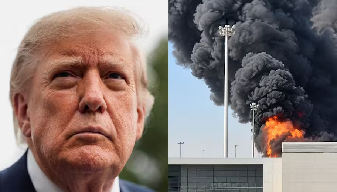

US President Donald Trump said Washington could join Saudi Arabia’s military strikes against Yemen’s Houthis after an attack on Riyadh’s international airport killed 12 people and injured 309. Trump said a decision would come quickly as Saudi authorities suspended airport operations and the kingdom’s forces pressed an offensive in Yemen, raising the prospect of deeper American involvement in the conflict.
Trump says US may join Saudi Arabia’s strikes on Houthis
Speaking to reporters, President Trump said the US is considering joining Saudi strikes on the Houthis and will make a swift decision following the recent attack.
“We may. We’re going to look at it. We just found out about the recent attack, so we’ll make a decision. We move very quickly,” he said.
Trump later said he planned to speak with Saudi Crown Prince Mohammed bin Salman about the attack. “What happened in Saudi Arabia is not acceptable,” he told reporters. When asked again about possible American involvement, the president replied, “We’ll find out.”
US Secretary of State Marco Rubio condemned the attack and confirmed that an American citizen was among those killed. He described the strikes as showing a blatant disregard for civilian lives and called for them to stop immediately.
Riyadh airport attack leaves 12 dead, 309 injured
The Saudi General Authority of Civil Aviation said Sunday’s updated casualty figures included four Saudi citizens and eight foreign nationals. Two of the foreign victims were Bangladeshis, while the others came from the United States, Egypt, Jordan, Syria, Palestine and Sudan.
Several injured passengers were reported to be in critical condition. Emergency teams rushed to King Khalid International Airport after the Saturday afternoon attack, which struck an area housing domestic terminals 3 and 4.
Airport operations were temporarily suspended, while flights were cancelled or diverted. The attack was the third at the Riyadh airport in a week. Two earlier strikes had killed four people and damaged a Saudi commercial aircraft.
Saudi Arabia’s military coalition blamed the Houthis and promised a firm response. The group had not immediately claimed responsibility for Saturday’s strike, although it had acknowledged attacks on the airport earlier in the week.
Saudi Arabia launches fresh strikes across Yemen
As Trump considered Washington’s response, fighting continued across Yemen. Houthi-run al-Masirah television reported that Saudi forces launched fresh air and missile strikes on Sanaa International Airport, areas near the Bab al-Mandab Strait and several northern provinces.
Yemeni government forces claimed that more than 1,150 Houthi fighters had been neutralised and over 180 military and logistical vehicles destroyed or damaged during more than 1,900 strikes in 24 hours. The figures could not be independently verified.
Clashes also continued around Taiz, where Houthi advances have threatened government positions and disrupted roads connecting the city with southern Yemen.
Following the Riyadh airport attack, the Houthis said they were prepared to consider reciprocal arrangements with Saudi Arabia to keep airports, seaports and other humanitarian facilities outside military operations.
Why Saudi Arabia and Houthis are fighting again
The latest confrontation follows the collapse of a period of relative calm in Yemen’s civil war. The conflict began in 2014 when the Houthis captured Sanaa and large parts of northern Yemen. Saudi Arabia intervened the following year to support the internationally recognised Yemeni government.
A UN-brokered truce in 2022 reduced major fighting, but hostilities resumed this year. The Houthis subsequently made territorial gains near the Bab al-Mandab Strait, a major shipping passage between the Red Sea and the Gulf of Aden.
On October 4, Saudi-backed Yemeni government forces launched a new offensive to recover Houthi-controlled territory. Saudi aircraft have supported the ground campaign, while the Houthis have intensified attacks on Saudi airports and other infrastructure.
The renewed conflict has also become connected to the wider war involving Iran, Israel and the United States. Trump has not announced a decision to join the latest Saudi military campaign, but his comments leave open the possibility of direct US strikes against Houthi positions in Yemen.
Why the Bab al-Mandab Strait is at the centre of the Saudi-Houthi fight
The current fighting is concentrated partly around Bab al-Mandab, the narrow passage linking the Red Sea with the Gulf of Aden and a vital route for international shipping. Saudi-backed Yemeni forces launched an offensive on Monday to regain territory the Houthis had captured near the waterway. Competing claims about who controls parts of the strait have not been conclusively verified.
Yemen’s war began after the Houthis seized Sanaa in 2014. A Saudi-led coalition intervened in 2015 in support of the internationally recognised government. A UN-brokered truce in 2022 reduced major fighting, but hostilities resumed this year. UN envoy Hans Grundberg has warned that Yemen has returned to full-scale war, with civilians bearing the consequences.