
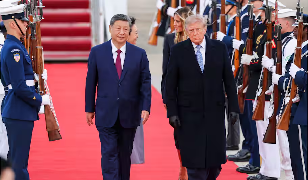

Hours after the US President Donald Trump gave Chinese President Xi Jinping a rare airport welcome, Washington announced a two-month extension of its trade truce with Beijing.
Trump and first lady Melania Trump welcomed Xi and his wife, Peng Liyuan, at Joint Base Andrews in Maryland on Wednesday evening, local time.
A red carpet, military honour guard and flyover marked the beginning of the Chinese leader’s state visit.
US- China trade truce extended until January 10
Shortly after Xi’s arrival, US Treasury Secretary Scott Bessent said the two countries had agreed to extend a trade arrangement that was due to expire on November 10, according to The New York Times. The extension will remain in place until January 10.
The bilateral trade truce known as the “Busan agreement”. The agreement was made in October 2025 meant to ease economic tensions between the two nations.
Under the arrangement, the United States is suspending certain tariffs and restrictions, while China is maintaining supplies of rare earth minerals used by American manufacturers, The Times reported.
Bessent told Fox News that the extension would ‘give us more time to see what we can do on the economic front’.
The announcement gave Xi’s visit an early outcome before Trump and Xi began their main talks. However, it did not resolve their broader disputes over trade, technology and security.
Unusual welcome at Joint Base Andrews
Xi’s aircraft landed shortly before 6 p.m., after which US personnel rolled out the red carpet. Trump and Xi, accompanied by their spouses, shook hands and stood for the national anthems. Two B-1 bombers flew overhead during the ceremony.
The Times reported that Trump smiled and patted Xi on the shoulder as they walked along the carpet. Presidents rarely greet foreign leaders at Joint Base Andrews, making the reception an unusual opening to the visit.
Back at the White House, Trump told reporters, ‘We have a packed house tomorrow night for President Xi’, The Post reported. A state dinner is scheduled for Thursday, along with a White House welcome ceremony and a planned visit to the National Archives.
AI and economic competition on agenda
Trump and Xi are expected to discuss artificial intelligence, investment and the economic competition between their countries.
According to The Times, Bessent has raised the possibility of creating a system through which the two countries would notify each other about AI incidents with national security implications. He said he believed China was willing to engage, although no such system has been announced.
Iran and Taiwan are also expected to feature in the talks. Trump said he would discuss China’s involvement with Iran, The Post reported, while Xi is expected to press Washington on its approach to Taiwan, according to The Wall Street Journal.
Wider disputes remain unresolved
The Journal reported that officials from both countries had spent weeks negotiating the form of Xi’s reception. It said more difficult issues, including advanced technology and geopolitical influence, remained largely untouched during those preparations.
The welcome also drew criticism in Washington. Senator Roger Wicker, chairman of the Senate Armed Services Committee, said he hoped Trump would press Xi on China’s military build-up and its support for Iran, according to The Times.
Secretary of State Marco Rubio defended the decision to meet, saying the two powers must deal with each other despite their disagreements.
Trump visited Beijing in May, and the two governments have since continued discussions on tariffs, agricultural trade, rare earth supplies and AI. Their latest agreement keeps the existing trade arrangement in place through January 10 as negotiations continue.
Xi’s visit is scheduled to run through Friday. The leaders’ main meetings were still ahead when Bessent announced the extension, leaving the outcome of the broader talks open.
(with agencies input)