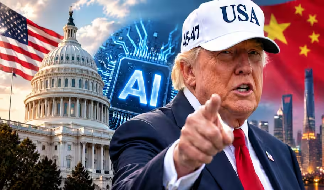

US President Donald Trump is planning an “AI Force” modelled on his Space Force and says a new “AI Czar” will be named soon, putting artificial intelligence at the centre of America’s technology push. The move comes as his administration warns that the United States cannot afford to lose the fast-moving AI race to China.
What is Trump’s new AI Force?
Trump announced the plan on Truth Social but left one major question unanswered: What exactly will the AI Force do?
The US President said the new body would be formed “much like” the Space Force, which was established during his first term. He did not give details about its structure, budget, powers or launch date. It is also unclear whether the AI Force would operate as a civilian body or have any military role.
Trump said he would announce an “AI Czar” in the near future. The person would become a key figure in his administration’s approach to artificial intelligence.
Trump says US will not slow AI growth
Trump made clear that his administration does not intend to put broad restrictions on the development of AI.
“We will not in any way hinder or stifle the Growth of this incredible Industry. Rather, we will cherish it, help it, and watch over it, as it grows! However, we will also be looking for BAD, and we can do that, very easily, with our already existing Criminal and Civil Justice System,” Trump said.
His position puts the focus on existing criminal and civil laws to deal with wrongdoing linked to AI rather than creating sweeping new restrictions on the technology.
Trump compares AI Force with Space Force
Trump’s comparison with Space Force has drawn attention because that organisation became a separate branch of the US military in 2019.
So far, however, Trump has not said that his proposed AI Force will become another military branch. Details about where it would sit within the US government have not been announced.
| Trump’s AI plan | What is known |
|---|---|
| AI Force | Trump says it will be formed and compared it with Space Force |
| AI Czar | A new adviser will be announced |
| Main approach | Support AI growth while using existing laws against criminal conduct |
| Structure and budget | Not announced |
| Launch date | Not announced |
Could AI become 25% of the US economy?
Trump described artificial intelligence as the next Industrial Revolution or Internet and said it could become even bigger. He claimed AI could eventually account for as much as 25 per cent of US gross domestic product.
He did not provide an economic study or other evidence for the 25 per cent figure in his announcement.
China looms over America’s AI push
The announcement also comes as Washington and Beijing compete over advanced AI technology. Both countries see the technology as important to economic and military power.
Earlier this week, US Attorney General Todd Blanche said America could not afford to fall behind China.
“We can’t lose the AI race to China, right?” Blanche said. “President Trump says that, everybody says that, but they say it because it’s true.”
Blanche said the Justice Department would pursue criminal activity involving AI but should not become the country’s technology regulator.
Why Trump’s AI announcement matters now
Trump’s plan comes during a dispute in the United States over how quickly AI should be developed and how much government oversight it needs.
Some lawmakers and technology figures have called for stronger safeguards as AI systems become more powerful. Trump has rejected calls to slow the industry and argues that restrictions could hurt American companies in their competition with China.
Trump also called concerns about the destruction caused by AI one of the “many hoaxes” promoted by Democrats. In the same post, he referred to other political disputes, including global warming, as hoaxes.
The White House has yet to explain how the AI Force would work or what authority its new AI Czar would have. Those details will determine whether Trump’s announcement creates a new government organisation or mainly changes how existing agencies handle artificial intelligence.