
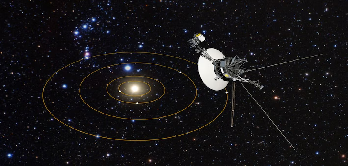

NASA’s Voyager 1 spacecraft has achieved another historic milestone, becoming the first human-made object to travel one light-day away from Earth. After nearly 49 years of continuous travel through space, the spacecraft reached the landmark distance of approximately 25.9 billion kilometres from Earth on November 18, 2026, at 3:46 pm IST.
The achievement highlights how far human space exploration has come since the spacecraft began its journey in 1977. Voyager 1 is currently the most distant human-made object from Earth and continues to send scientific information back to scientists despite operating with ageing technology.
A journey that began in 1977
NASA launched Voyager 1 on September 5, 1977, 16 days after its twin, Voyager 2. The mission was first planned to study the outer planets, mainly Jupiter and Saturn.
Voyager 1 passed Jupiter in 1979 and Saturn in 1980. It sent back detailed observations of the planets, their moons and their rings.
In 1990 it took the “Pale Blue Dot” photograph, which shows Earth as a tiny speck in the dark of space.
In August 2012 it crossed the heliopause, the outer edge of the Sun’s bubble of particles and magnetic fields. That made it the first spacecraft to enter interstellar space, the region beyond the reach of the solar wind.
How it still works after 49 years
Voyager 1 does not use solar panels. It gets its electricity from radioisotope thermoelectric generators (RTGs), which turn the heat from the decay of plutonium-238 into power.
The power output drops over time, so keeping every system running is hard. To save electricity, NASA engineers have been switching off some science instruments and non-essential systems. The spacecraft still runs on onboard computers and memory built in the 1970s.
NASA hopes to keep the Voyager missions going into the mid-2030s.
Where it is heading
Voyager 1 is still far from any other star. The nearest star system, Alpha Centauri, is more than four light-years from Earth.
The spacecraft is moving toward Gliese 445. In about 40,000 years it is expected to pass within roughly 1.7 light-years of that star.
Voyager 1 also carries the Golden Record, a gold-plated disc holding sounds, music, greetings in several languages and images of life on Earth. It was put on board as a message for any extraterrestrial civilisation that might find the spacecraft one day.
A probe launched almost half a century ago is still moving through interstellar space, carrying a small piece of Earth with it.