

Ruth Pollard 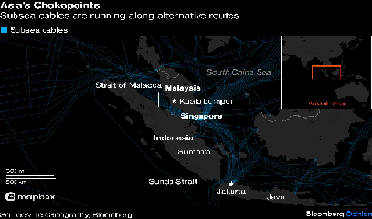
When Australia’s Defence Minister Richard Marles described the seabed as a battlefield at a regional defense gathering in Singapore earlier this year, he was preaching to the converted. The security of undersea cables – which carry more than 95% of data flows and trillions of dollars of daily financial transactions – was already top of mind for the senior military brass, geopolitical analysts and government ministers in the room.
A new project by Australia, the UK and the US was quickly announced to develop underwater drone technology to protect cables by 2027, while Singapore launched a 17-country framework covering Southeast Asia, Europe, the Middle East and Oceania to explore defense cooperation on critical infrastructure.
But while nations are racing to defend existing networks, the companies building Southeast Asia’s digital architecture face a different challenge: avoiding maritime bottlenecks and the risk posed by China’s expanding sea presence. The Strait of Malacca, the narrow passage between Indonesia, Malaysia and Singapore, is particularly vulnerable due to the sheer concentration of cables traversing the corridor.
Already considered the Indo-Pacific’s most critical chokepoint – it handles about 21% of global maritime trade by value – the Strait is increasingly being bypassed by major private subsea cable projects. Google’s TalayLink, for instance, will connect Australia and Thailand via the Indian Ocean following a route west of the Sunda Strait that avoids the congested corridor.
But concentration isn’t the only risk. Nowhere is the geopolitical contest over cable routes more evident than in the South China Sea, where China is using regulation and maritime enforcement to control who can build and repair cable infrastructure across the contested waters. Beijing is effectively trying to redraw the undersea cable map, while the US and its partners are finding new ways to push back.
Google and Meta Platforms Inc.’s Echo cable – which links the US to Singapore via Guam and Indonesia – shows how tech companies are redesigning Asia-Pacific networks to reduce their exposure to China. These giants have decided that avoiding Beijing is worth the added costs and the risk of laying cables in less suitable terrain.
Of course, it’s tempting to dismiss this as yet more collateral damage from the US-China competition. But it will have long-lasting consequences. The routes chosen for this eye-wateringly expensive critical infrastructure will impact the region for decades to come, cementing ties between nations and increasingly isolating others. Samuel Bashfield, a research fellow at Melbourne-based La Trobe University and the author of two recent books including one on submarine cables, has written that installers are increasingly wary of working in the South China Sea, with many avoiding the area altogether.
Beyond deploying Chinese Coast Guard ships to harass repair crews or prevent them from accessing the cable grounds, Beijing has effectively locked out non-Chinese subsea fiber projects through onerous permitting requirements, he said. These delays have forced some new projects to reroute entirely, hugging coastlines and plowing cables into shallow seabeds, a less-than-ideal solution for network resilience, Bashfield told me.
The $700 million Asia Connect Cable System, led by startup Inligo Networks, for example, will skirt the South China Sea by running through Indonesia and the Philippines. The Pacific Light Cable Network, linking the US to Taiwan and the Philippines, underwent a similar transformation after its planned Hong Kong connection was abandoned following American intervention.
The US has devoted considerable effort to convince Southeast Asian and Pacific nations to shun Chinese vendors in favor of American, Japanese or European alternatives. Both superpowers fear that foreign involvement in cable infrastructure could enable intelligence gathering or sabotage. Washington regards Chinese technology as a security risk, while Beijing has raised similar concerns about American and Japanese equipment.
Amid mounting US scrutiny, Huawei agreed in 2019 to sell its 51% stake in Huawei Marine Networks to China’s Hengtong Optic-Electric, which also acquired its British partner’s interest. The cable-building business was subsequently renamed HMN Technologies Co. Yet its ownership and technological origins mean the US and allies like Japan and Australia want to reduce its use across Asia.
They have clocked up some recent successes: In August, Australia announced that every Pacific Islands Forum member was connected to the global undersea cable network for the first time. That’s a significant achievement, but it doesn’t mean that Chinese companies have been excluded from the Pacific altogether. The next battleground is data centers. Countries financing submarine cables will also need to help build the infrastructure needed to store and process data locally, or risk Chinese suppliers filling that gap.
Much of that work will fall to Japan, which plays a critical role both as a manufacturer and as a connectivity hub between North America and Asia. NEC Corp. alone is one of the world’s largest subsea cable builders. Tokyo needs to utilize groupings such as the Quad that includes the US, Japan, India, and Australia, as well as the Association of Southeast Asian Nations, to strengthen systems in the Indo-Pacific and expand cable-laying capacity to help reduce China’s dominance. Asean leaders are due to gather in Manila next month, where a Quad leaders’ meeting is also planned. Undersea cable security should be high on their agenda.
There is, however, an irony in efforts to curb Beijing’s influence over critical cable routes: Much of that power is instead concentrating in the hands of a small group of American technology giants. What could possibly go wrong?