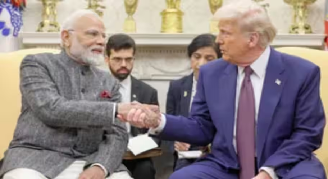

US President Donald Trump said India was keen to finalise a trade agreement with the United States, suggesting that the two countries were nearing a deal. However, he indicated that the proposed agreement would be substantially different from previous trade arrangements.
Trump made the remarks while speaking to reporters in the Oval Office alongside Vice President JD Vance, in response to a question about the progress of trade negotiations between Washington and New Delhi.
“They want to make a deal. We’re going to make a deal pretty close,” Trump said.
“Yeah, that’s going to be a much different kind of deal than we’ve made,” he added.
The remarks came during Secretary of State Marco Rubio’s visit to India, where he held talks with External Affairs Minister S. Jaishankar, against the backdrop of high-level diplomatic engagement between the two countries.
Trump did not provide details on how the proposed trade deal would differ from previous agreements. He also did not indicate a timeline for concluding negotiations or specify the outstanding issues holding up a final agreement.
However, his comments suggested that Washington anticipated progress in the negotiations, which have drawn close attention from businesses, exporters and investors in both countries.
India and the United States have been engaged in negotiations for a bilateral trade deal intended to improve market access and resolve long-standing disagreements over tariffs, agricultural products, industrial goods and regulatory restrictions.
The talks have gained greater importance under Trump’s second administration, which has placed tariffs and reciprocal market access at the centre of its economic policy. The administration has maintained that trading partners should provide better access to their markets for American businesses and lower barriers to US exports.
For India, the proposed agreement could have significant implications for key export sectors, including pharmaceuticals, engineering goods, textiles, electronics and information technology-related services.
Meanwhile, US companies are seeking to expand their presence in India’s growing consumer market and manufacturing industry.
However, Trump’s latest remarks offered no indication of whether negotiators had resolved sector-specific differences or reached an understanding on reducing tariffs.
He did not announce any fresh investment commitments, market-access concessions or a timeline for implementing the proposed agreement.
During the interaction, Trump also addressed efforts to narrow the US trade deficit with major trading partners. Citing Canada, Mexico and the European Union, he argued that his administration’s trade policies were reshaping long-established commercial relationships.
The President claimed that the US economy was growing strongly and attracting significant new investments in manufacturing and industrial facilities. He described the administration’s tariff and trade policies as part of a broader strategy to boost domestic production and employment.
While Trump did not specifically address India’s tariffs or its trade surplus with the US, his comments on the proposed bilateral agreement came against this wider economic backdrop.
The remarks followed months of negotiations between officials in Washington and New Delhi over the terms of a bilateral trade arrangement.
Both countries have identified trade and investment as key pillars of their relationship, alongside defence cooperation, technology partnerships and energy security.
The US is one of India’s largest trading partners, with bilateral trade covering both goods and services. Their economic ties also encompass significant investment flows and commercial partnerships across technology, pharmaceuticals, manufacturing and financial services.