
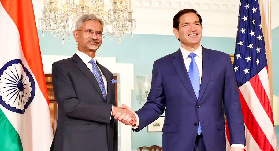

US Secretary of State Marco Rubio will be in India on a two day visit, covering two major cities, Mumbai and Jamnagar, described as the prominent strategic importance in contemporary India-US relations by the Secretary himself. Rubio, ahead of his visit, acknowledged India’s energy needs and Russian oil imports and remaked that every country has a complex set of factors that it has to take into account.
“Geography is real. For some countries, it’s very difficult to acquire energy from alternative sources. That’s not an excuse, but all of that has to be balanced when making foreign policy,” he said.
Rubio also said that US is “very close” to finalising a trade agreement with India.
But questions remain over whether the Washington is softening its approach or simply recalibrating its pressure on New Delhi?
A waiver, not a white flag
Days ahead of Rubio’s India visit US President Donald Trump temporarily waived tariff and sanctions provisions under the Lindsey O Graham Sanctioning Russia and Iran Act of 2026, giving Washington 60 days to assess the economic implications.
The legislation would have allowed tariffs of up to 100% on goods imported from the five largest buyers of Russian-origin crude oil or natural gas, including India and China.
Speaking in Uzbekistan, the Secretary said the administration needed to consider the impact of such measures on the US and global economies. He acknowledged that India had diversified its energy portfolio but could not immediately replace substantial Russian supplies.
India was also an important American ally and partner, he said, arguing that geography and access to alternative energy sources had to be considered in foreign policy decisions.
Former Indian ambassador Manjeev Singh Puri, welcomed the remarks but cautioned against interpreting them as a fundamental policy shift. He said that Wordsmithy is a necessary act of diplomacy and suggested that Rubio’s conciliatory language was appropriate ahead of his visit.
Puri argued that Washington continued to pursue its own interests, while recognising that India remained important to the US.
He welcomed the waiver but hoped the administration would maintain the same approach after the 60-day period.
The relief, however, is temporary. The underlying legislation remains in force, leaving Washington with the option of reinstating the duties.
The waiver must also be distinguished from tariff relief under a bilateral trade agreement. While the former concerns penalties linked to Russian energy purchases, the latter involves the broader terms of trade between the two countries. Both can nevertheless influence negotiations.
The Russian oil double standard
Washington’s position has raised questions about the consistency of its approach to Russian energy.
Trump recently announced an agreement under which Russia would supply more than 300,000 tonnes of diesel immediately, followed by additional shipments. The move came amid concerns over fuel prices and domestic supply in the US.
Former Indian diplomat KP Fabian argued that Washington’s own decision to purchase Russian energy undermined the logic of penalising other countries for doing the same.
“The US has decided to buy oil from Russia, and therefore, if you want to follow logic, the US should sanction itself,” Fabian said. “So if the US itself is buying, how can the US sanction India?”
For Fabian, Rubio’s remarks do not amount to a recognition or rejection of India’s strategic autonomy. Instead, they expose the tension between Washington’s pressure on Russian energy buyers and its own commercial requirements.
Rubio has also cited wider geopolitical pressures, including the Russia-Ukraine war, attacks on energy infrastructure and escalating tensions involving Saudi Arabia and the Houthi militia, as factors affecting global supplies and prices.
US Treasury Secretary Scott Bessent on the contrary said Washington had asked European allies to join it in imposing secondary tariffs on India and China over Russian oil purchases, but they had refused.
“So why should the US bear the burden?” Bessent asked.
The dispute highlights the limits of using economic pressure to influence India’s energy choices.
New Delhi has increased purchases from other suppliers, but replacing Russian crude is not simply a political decision; prices, availability and energy security also matter.
Rubio’s acknowledgement of these constraints is significant. Whether it leads to a lasting change in policy remains uncertain.
Trade deal: Close, but not quite there
Rubio’s claim that a trade deal is close to finalisation has raised expectations ahead of his visit. However, previous indications that an agreement was imminent have yet to produce a completed deal.
Fabian urged caution, pointing out that similar assurances had been made before.
“We have been told many a time that a trade deal is almost finalised. It’s imminent and all that. But till now, that has not been the case,” he said.
He also questioned whether Rubio’s discussions with External Affairs Minister S Jaishankar would resolve the outstanding trade issues, arguing that Commerce Minister Piyush Goyal was the appropriate counterpart for negotiations.
Puri sugested that substantial progress had already been made and that an agreement could emerge soon. He added that keeping expectations measured was part of managing the political dimension of negotiations.
The tariff waiver may improve the negotiating atmosphere, but the possibility of renewed duties leaves India vulnerable to further pressure. Progress on trade and the future of the waiver will therefore remain separate, though closely connected, tests of the relationship.
Jamnagar and meating with business leaders
Rubio’s planned visit to Jamnagar brings energy cooperation and commercial investment into focus.
Speaking to ANI, foreign affairs expert Robinder Sachdev suggested that the visit could be linked to Reliance Industries’ proposed refinery investment in Brownsville, Texas. In March 2026, Trump announced a $300 billion partnership with Reliance for the “America First Refining” project. Sachdev clarified that the headline figure was not the refinery investment itself, which he estimated at around $5 billion.
Sachdev speculated that Washington could be seeking a formal announcement on the project, allowing Trump to highlight investment and job creation ahead of the US midterm elections. He also suggested that it could provide political talking points for Republicans in Texas. These are his assessments of the possible motivations behind the visit, not confirmed reasons for Rubio’s itinerary.
Puri also linked the Jamnagar stop to American oil interests and Reliance’s investment plans.
The US Department of State has said Rubio will meet business leaders to promote commercial investment and economic cooperation, alongside discussions on energy and strategic ties.
Sachdev believes Washington is placing greater emphasis on commercial deals, with trade negotiations and the strategic partnership increasingly treated as separate, though connected, tracks.
For India, this could create opportunities if discussions produce concrete investment commitments. But it also raises a broader question: is Washington strengthening the partnership on its strategic merits, or increasingly measuring engagement by the economic benefits it can secure?
A reset or the usual playbook?
Rubio’s visit offers an opportunity to stabilise relations, but neither expert sees sufficient grounds to declare a fundamental shift in Washington’s approach.
Fabian believes the US continues to seek concessions from New Delhi, while expressing confidence in India’s ability to manage the pressure through diplomacy.
“I don’t think Washington has stopped trying to extract more and more concessions from India,” he said.
Ex-ambassador Puri, meanwhile, rejected the idea that the relationship was undergoing a clear transition. Both countries, he argued, continue to pursue their national interests, while the importance of their partnership repeatedly draws Washington towards engagement with New Delhi.
That may be the central calculation behind Rubio’s visit. The US has reasons to preserve its relationship with India, but domestic economic priorities and geopolitical considerations can also shape its decisions. The tariff waiver, American purchases of Russian diesel and the prospect of commercial investment all illustrate these competing pressures.
For India, the visit will be more about whether it delivers tangible progress on trade, greater predictability over energy-related penalties and stronger cooperation on shared strategic priorities.