
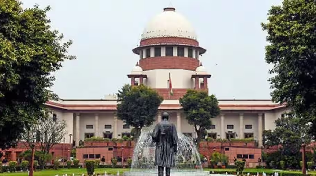

The Supreme Court expressed strong displeasure over the Election Commission of India’s (ECI) failure to trace the video recording of the 2023 vote counting in Karnataka’s Sringeri Assembly constituency. The court warned that it could draw an adverse inference against the poll body if it failed to produce the available records at the next hearing.
A bench comprising Justices Sanjay Kumar and Sanjeev Sachdeva expressed surprise at the ECI’s submission that the footage could not be located, questioning how the poll body could lose records related to an election it was responsible for conducting.
“How can the Election Commission of India (ECI) say that it has lost its record? Your whole purpose is to hold an election, and you need to have a document,” the bench said, as reported by Bar and Bench.
The court was not satisfied with the ECI’s explanation that attempts were underway to locate the footage and directed the poll body to submit all available records at the next hearing. The matter is scheduled to be heard on February 15, 2027.
The Supreme Court’s observations came during proceedings over the Sringeri Assembly seat, where Congress leader TD Rajegowda was initially declared the winner in the 2023 Karnataka Assembly elections by a narrow margin of 201 votes.
BJP candidate DN Jeevaraj challenged Rajegowda’s victory, setting off a legal battle that eventually resulted in a recount of postal ballots and a subsequent change in the election result.
Top court raps ECI over inability to present video of vote counting
During Wednesday’s hearing, the bench was informed that Rajegowda had sought access to the election observer’s report and video recordings of both the original vote count in 2023 and the subsequent recount.
When the court asked the Election Commission of India (ECI) to produce the relevant documents and footage, senior advocate Seshadri Naidu, representing the poll body, submitted that the recording of the original counting process could not be located.
The explanation failed to convince the bench, which questioned the Commission’s responsibility to preserve records related to the elections it conducts.
“Where is the question of you saying, ‘Yeah, we are trying to trace it’? You gave it to the elected candidate. There is no custody of records,” the court said, according to Bar and Bench.
The bench directed the Commission to submit all available records at the next hearing, cautioning that failure to do so could invite adverse consequences.
“Whatever you have, produce it on the next date. Otherwise, we will have to draw an adverse inference against you. We will not accept these kinds of lame excuses,” the court said, as reported by Bar and Bench.
What is the case?
The dispute originated from an election petition filed by BJP candidate DN Jeevaraj before the Karnataka High Court, challenging Congress leader TD Rajegowda’s victory in the 2023 Assembly elections.
On April 6, the High Court directed a recount of postal ballots, including the re-examination of 279 ballots that had initially been rejected.
Following the recount, the returning officer announced the revised election result on May 3, 2026. Rajegowda’s vote count was reportedly reduced by 255, resulting in Jeevaraj being declared the winner.
Rajegowda subsequently moved the Supreme Court, challenging the revised outcome and the procedure followed during the recount.