
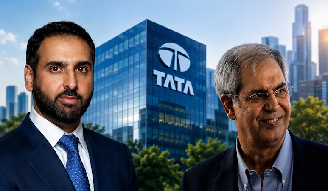

Amid an escalating battle over the governance of Tata Trusts, chairman Noel Tata and his son Neville Tata have taken another legal precaution. The two have filed caveats in the Bombay High Court, a week after making similar filings in the Mumbai City Civil Court, sources told NDTV Profit on Wednesday.
The move comes amid a dispute involving trustees Venu Srinivasan and Vijay Singh, who have approached the Maharashtra Charity Commissioner with allegations of governance lapses at the Sir Dorabji Tata Trust (SDTT).
The caveats are intended to ensure that Noel Tata and Neville Tata get an opportunity to present their side before the courts pass any orders in matters concerning them. The filings do not, by themselves, mean that a court case has been decided or that any allegations have been established.
Noel Tata and Neville Tata filed the caveats in the Mumbai City Civil Court on October 7, 2026. They have now extended the legal precaution to the Bombay High Court.
The filings name co-trustees Venu Srinivasan, Vijay Singh, Darius Khambata and Bhaskar Bhat as caveatees, sources said. The inclusion of Khambata and Bhat is procedural, according to sources at Tata Trusts.
A caveat is a formal notice asking a court to give the person filing it an opportunity to be heard before passing an order in a matter covered by the notice. It does not amount to a ruling on the merits of a dispute. The filings come as tensions over the administration of the Sir Dorabji Tata Trust spill into the legal and regulatory arena.
Tata Trusts Gets More Time To Respond To Trustee Complaint
On Tuesday, Tata Trusts received an extension from the Maharashtra Charity Commissioner until October 19 to respond to a complaint filed by Srinivasan and Singh. The original deadline was October 12.
The complaint raises questions about governance at SDTT and alleges that the trust overstepped its role as a charitable trust in transactions involving Tata Sons.
Towards the end of September, Srinivasan, an SDTT trustee and a nominee director on the Tata Sons board, sought an immediate inquiry into the trust’s administration and governance.
In a letter titled “Illegal and Irregular Appointment of Perpetual Trustee and Serious Governance Lapse”, he said he was acting “with a view to preserving the institutional integrity and proper administration of SDTT”. He also sought a freeze on changes to the SDTT board while the inquiry is underway.
The allegations are part of a complaint that is yet to be resolved. Tata Trusts has been given until October 19 to submit its response.
Why Venu Srinivasan Has Raised Questions Over Trust Governance
At the centre of Srinivasan’s complaint is SDTT’s Circular Resolution No. 107, circulated on September 16. He alleged that the resolution was “an extraordinary attempt to prevent me from exercising my independent judgement and vote”. He further claimed that it was intended “to neutralise my position as a Trustee because it differed from that of certain other Trustees”.
Srinivasan went on to allege that the move was an attempt to consolidate power within the trust and influence decisions at Tata Sons. “More fundamentally, it was an attempt to effect a power grab within SDTT and, through it, to dictate what Tata Sons should do instead of allowing its Board to objectively evaluate the available alternatives on their merits,” he wrote.
He also linked the latest dispute to his exclusion in November 2025. “Viewed alongside my earlier exclusion in November 2025, it forms part of a continuing effort to suppress differing views and concentrate decision-making power within a smaller group of Trustees,” the letter stated.
These are Srinivasan’s allegations. The complaint seeks regulatory scrutiny of the trust’s administration, and the allegations should not be treated as findings of wrongdoing.
Following the complaint, multiple trusts within the Tata Trusts group filed 84 caveats before the Maharashtra Charity Commissioner, according to sources aware of the filings. The move was aimed at ensuring the trusts are heard before any orders are passed in matters concerning them.
Speaking on the development, Gaurav Singh Counsel at Clavius Legal, told NDTV, “With caveats in the City Civil Court and the Bombay High Court, and 84 more before the Charity Commissioner, both camps clearly expect the Commissioner’s ruling on the Srinivasan-Vijay Singh complaint to be challenged, whichever way it goes.”
He added, “Two legal questions sit at the heart of the complaint. One is whether the perpetual trustee appointment survives the 2025 amendment to the Maharashtra Public Trusts Act, which caps perpetual trustees at one-fourth of a trust’s board unless the trust deed specifically provides for them. The other is whether SDTT could use Circular Resolution No. 107 to stop a trustee from voting as a Tata Sons director, when Section 166 of the Companies Act requires every director to exercise independent judgment.”
What Is The Tata Row About? The Wider Tata Sons Dispute Explained
The dispute over trust governance comes against the backdrop of a larger disagreement over Tata Sons, the holding company of the Tata Group. Tata Trusts holds around 66 per cent of Tata Sons, while the Shapoorji Pallonji Group owns about 18.37 per cent. Tata Group companies and other shareholders hold the remaining shares.
The question of whether Tata Sons should go public has been a key point of disagreement. The Shapoorji Pallonji Group has pushed for a public listing, while Noel Tata has opposed an immediate IPO and argued that alternatives should be explored.
The listing debate is linked to regulatory requirements after the Reserve Bank of India rejected Tata Sons’ request to surrender its registration as a Core Investment Company in September 2026.
For the Shapoorji Pallonji Group, a listing could provide a market for its stake and improve transparency. Noel Tata and Tata Trusts, meanwhile, have argued that the company’s existing ownership structure is closely linked to the group’s philanthropic model.