
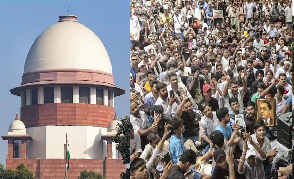

Can the government restrict public movement, disrupt internet access and detain thousands of people during a protest without suspending their fundamental rights?
That question came before the Supreme Court on Sunday (October 11), following a legal challenge to the Delhi Police’s crackdown on people who tried to protest at Jantar Mantar on October 10 and the resulting restrictions on public transport, internet services and peaceful assembly.
During the special hearing, Senior Advocate Menaka Guruswamy invoked Article 358 of the Constitution. She asked whether the measures taken in the capital amounted to an undeclared Emergency.
She questioned why metro stations had been closed, internet services disrupted and more than 7,000 people were detained during the protest against Chief Election Commissioner Gyanesh Kumar.
Guruswamy argued that Article 19 rights could be suspended under the constitutional provision only in the specific circumstances laid down for a national Emergency. Her reference brought the distinction between emergency powers and the ordinary limits on government action into the courtroom.
A bench of Justices Joymalya Bagchi and V Mohana heard petitions challenging the police action and restrictions imposed around the October 10 protest. Appearing for the government, Solicitor General Tushar Mehta disputed the allegations and said the Centre needed time to respond because the petitions had not been supplied to it.
What is Article 358 of the Constitution?
The Article 358 falls under Part XVIII of the Constitution, which deals with Emergency provisions. It deals with the impact of a national Emergency on the fundamental rights guaranteed under Article 19.
The provision applies when a Proclamation of Emergency declares that India’s security, or the security of any part of its territory, is threatened by war or external aggression. During such an Emergency, Article 19 does not restrict the State’s power to make laws or take executive action within the scope of Article 358.
This does not mean the government can suspend freedom of speech whenever it faces protests or a law-and-order challenge. Article 358 applies only during a constitutionally proclaimed Emergency on the specified grounds. Its operation is also subject to conditions in the Constitution, including requirements governing laws made under the provision. Once the relevant Emergency ends, laws that could not otherwise have been made cease to have effect to the extent set out in Article 358.
The distinction is important in the Delhi case. A police order restricting gatherings, a decision to close a metro station or an internet shutdown does not, by itself, bring Article 358 into effect. Such measures must be assessed under the legal provisions used to impose them and the constitutional protections that continue to apply.
The Article 358 was amended by the 44th Constitutional Amendment in 1978. Its scope was narrowed so that it applies to an Emergency declared on grounds of war or external aggression, rather than one declared on the ground of internal disturbance. The amendment followed the experience of the 1975-77 Emergency and sought to place stronger safeguards around fundamental rights.
What rights does Article 19 protect?
The provision guarantees several freedoms to Indian citizens. These include the freedom of speech and expression, the right to assemble peacefully and without arms and the right to form associations or unions. It also protects the freedom to move throughout India, reside and settle in any part of the country and practise a profession or carry on an occupation, trade or business.
These freedoms are not absolute. The Constitution allows reasonable restrictions on specific grounds. For example, freedom of speech may be subject to restrictions on grounds such as public order, security of the state and other reasons listed in Article 19(2). The right to assemble peacefully can also be regulated under Article 19(3), including on grounds of public order.
The legal question in any protest-related case is whether the restrictions have a valid legal basis and comply with constitutional limits. Authorities may take lawful steps to prevent violence or serious disruption, but the existence of a protest does not automatically remove citizens’ fundamental rights.
Article 358 must also be distinguished from Article 359. Article 359 allows the president, during a proclaimed Emergency, to suspend the right to move courts for enforcement of specified fundamental rights, subject to constitutional limits. Article 358 deals specifically with the operation of Article 19 during an Emergency declared on grounds of war or external aggression.
What did SC say about restrictions in Delhi?
The Supreme Court’s intervention followed restrictions imposed ahead of the CJP’s planned demonstration at Jantar Mantar. Protesters were demanding Kumar’s resignation over alleged irregularities in the Special Intensive Revision (SIR) of electoral rolls. The Election Commission has defended the revision exercise, while Opposition parties have alleged that it could exclude eligible voters.
The court had objected on October 9 to a complete shutdown of metro and railway services, saying such a step would cause serious inconvenience to commuters. On Sunday, it directed authorities to restore normal metro and railway operations, ensure internet services were not disrupted unlawfully, remove barricades that obstructed movement and allow people to move freely. It also emphasised that people assembling peacefully should not face illegal detention.
The bench said the administration could take lawful measures if there was a serious threat to public order. It also told protesters to maintain peace and asked that lawyers be allowed to perform their professional duties without obstruction.
The government rejected the allegations made in the petitions. SG Mehta told the court that restrictions had been imposed at 45 of the 303 stations in the Delhi Metro network on October 10. The court sought a response from the Centre and agreed to hear the parties further.