
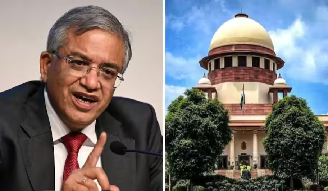

The Supreme Court on Monday (October 5) refused to pass an interim order seeking the suspension of Chief Election Commissioner Gyanesh Kumar over allegations that decisions related to the Special Intensive Revision (SIR) of electoral rolls were taken without the concurrence of the other two election commissioners.
A bench headed by Chief Justice of India Surya Kant and comprising Justices Joymalya Bagchi and V Mohana issued notice to the Election Commission of India (ECI), Gyanesh Kumar and the other two election commissioners, Sukhbir Singh Sandhu and Vivek Joshi.
The petitions question whether the chief election commissioner can exercise powers vested constitutionally and legally in the multi-member EC without the approval of the other commissioners. The pleas also seek an SIT inquiry into alleged voter deletions and challenge the manner in which decisions about electoral rolls and the SIR were taken.
SC asks EC to explain decision-making
Appearing for the petitioners, Senior Advocate Vikas Singh told the bench, “Every citizen of the country is feeling that the Election Commission’s credibility is at stake.”
Arguing for interim relief, he said, “ECs and ECI are more powerful today than any other constitutional authority.”
He also told the court that the prime minister and judges do not have the protection that, according to him, the EC enjoys today.
“I am wanting an interim order today to suspend the chief election commissioner,” he submitted.
At another point, Singh told the bench, “If no interim order is passed, the country will burn.”
Though the court did not grant the interim suspension, it issued notice to the poll panel and the three election commissioners and sought a clear response to the allegations.
“They will respond to us, and we expect them to respond clearly,” the bench said.
The top court also examined the petitioners’ claim that some decisions had been taken without the concurrence of Sandhu and Joshi.
CJI Surya Kant said election commissioners are expected to take unanimous decisions. A majority decision applies when unanimity is absent.
“They are expected to make unanimous decisions. If there is no unanimity, it has to be by majority. Today, you are going only on a news report,” he told Singh.
The court also hinted that it could reconsider decisions cited in the petitions if the records show that they were taken without the required unanimity.
“After notice, if they come and show that ABC decisions were taken without unanimity, we will take those decisions back,” the court said.
What the petitions say about CEC powers
The petitions challenge the individual exercise of powers that the Constitution assigns to the EC as a multi-member body.
The plea refers to Article 324 of the Constitution. It says the provision vests the superintendence, direction and control of elections in the “commission” and not in an individual chief election commissioner.
The petitioners have also relied on Section 18 of the Chief Election Commissioner and Other Election Commissioners (Appointment, Conditions of Service and Term of Office) Act, 2023. The provision deals with collective decision-making by the EC. The plea says decisions where there is no unanimity have to be taken by majority.
The petitions seek enforcement of this collective decision-making process. They also seek a writ in the nature of quo warranto questioning the authority under which the CEC allegedly acted in the name of the poll panel.
The matter was first mentioned before the CJI Surya Kant on September 29 by Singh. The chief justice had then said, “List it next week.”
The Supreme Court took up the matter on October 5.
14 objections cited against SIR decisions
A major part of the petitions deals with written communications and file notings from Election Commissioners Sandhu and Joshi.
The petitioners have cited at least 14 objections recorded by the two commissioners between October 2025 and August 2026. These objections relate to decisions and steps allegedly taken in the name of the EC without their approval. The 14 objections were also reported in The Indian Express before the petitions reached the top court.
The issues cited in the plea include communications and orders allegedly issued without approval from the poll panel, the absence of agendas before meetings and minutes after meetings, foreign travel undertaken without approval, changes to Form 6, access to the electoral roll database and appeals filed before tribunals in West Bengal.
The petitioners have also referred to objections over the “gradual centralisation of the electoral roll database” and changes in the work allocation of the EC’s IT establishment.
The petitions seek a declaration that powers vested in the EC under Article 324 cannot be exercised or represented as an act of the poll body outside the constitutional and statutory process governing the commission.