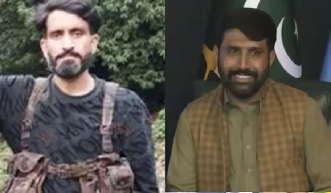

A day after Indian forces said they had neutralised LeT commander Hashim Musa in Jammu and Kashmir, Pakistan’s military held a high-profile press conference featuring a retired soldier named Mohammad Asif. Pakistan said he was alive and well and rejected reports linking him to the militant killed in Budgam. Indian social media users and OSINT accounts subsequently circulated facial comparisons between the two men, citing apparent visual differences. Those comparisons, however, have not been independently verified.
India kills Hashim Musa after months-long hunt
Indian security forces said they killed Musa in an intelligence-led operation in Jammu and Kashmir’s Budgam district on September 30. He was identified as “Musa, aka Asif Fauji”, a senior Lashkar-e-Taiba commander who had been tracked for months under Operation Sheruwali.
Officials said Musa was the last surviving member of a four-man LeT group that had operated in Jammu and Kashmir since 2022. Indian authorities linked the group to several attacks on civilians and security personnel, including the April 2025 Pahalgam attack in which 26 civilians were killed.
The other members of the group were identified by Indian authorities as Junaid Bhat, Suleiman Shah and Yasir.
According to Indian official accounts and media reports, Musa was a former member of the Pakistan Army’s elite Special Services Group (SSG). Reports said he had served in the SSG and was posted to former Pakistan President Pervez Musharraf’s security detail between 2006 and 2008 before entering the Lashkar-e-Taiba network and operating in Jammu and Kashmir.
Pakistan presents Mohammad Asif before cameras
On October 1, a day after Musa was reported killed, Pakistan’s military presented retired SSG Havildar Mohammad Asif at a press conference led by Inter-Services Public Relations Director General Lt Gen Ahmed Sharif Chaudhry.
Pakistan used Asif’s appearance to reject Indian reports linking the identity of the militant killed in Budgam to a former Pakistani soldier.
During the conference, Asif told reporters that he had joined the Pakistan Army in 2000, entered the SSG in 2005 and retired in 2023. He said he was at home when friends began calling after social-media reports claimed he had been killed in Kashmir.
“Yesterday, some friends called me and told me there were reports on social media that the Indian army in Kashmir had martyred me. To their concerns, I responded that I was here, alive and healthy.”
Pakistan’s military spokesman used the appearance to accuse India of falsely linking the retired soldier to the LeT commander. Pakistan’s state broadcaster reported that Asif had been living in Attock district since retiring from the army in 2023.
Question over Hashim Musa’s identity remains
The dispute centres on the names attached to Musa. India’s Home Ministry did not identify the slain commander simply as Mohammad Asif. Its September 30 statement called him “Musa, aka Asif Fauji”. The Chinar Corps account used the fuller identification “Mohammad Asif, alias Hashim Musa”.
Pakistan then presented a retired soldier named Mohammad Asif and treated his appearance as a rebuttal to the Indian account.
After the Pakistani press conference, Indian social media users and OSINT accounts compared the man shown alongside Lt Gen Chaudhry with older photographs circulated as Hashim Musa.
The comparisons claimed differences in the ears, nose, eye position and other facial features. India Today reported the claims but said the comparisons had not been independently verified. No publicly released biometric or forensic comparison has established whether the retired soldier presented by Pakistan and the militant killed in Budgam were the same person.
Indian military veterans question Pakistan’s version
Retired Indian military officers publicly challenged Pakistan’s presentation.
Major General Harsha Kakar (Retd.) wrote on X that Pakistan had “produced a fake individual” and suggested that the person would not be seen again. His assessment is a personal claim and does not constitute independent evidence establishing the identity of the man presented by Pakistan.
“Pak as usual produced a fake individual and named him Hashim Musa, aware that the truth is out. The individual will never be seen again. Nothing new from a lying Pak,” he said.
Who was Hashim Musa?
Musa was part of a four-member LeT group blamed for a series of attacks on civilians and security personnel in Jammu and Kashmir. The Home Ministry linked the group to incidents at Halan, Dehra Ki Gali, Kandi, Shahsitar, Shiv Khori, Gagangir, Bootapathri and Baisaran.
Officials also linked Musa to the network behind the April 2025 Pahalgam terror attack. He was described as a close associate of Suleiman Shah, whom security agencies identified as one of the main planners of the attack. Shah was later killed along with two other militants.
Musa had escaped earlier security operations as the other members of the group were killed one by one. Indian authorities said Junaid Bhat was killed in December 2024, Suleiman Shah in July 2025 and Yasir in September 2026. Musa’s death in Budgam, according to the Indian account, ended the hunt for the fourth member of the LeT group linked to the Pahalgam killings.