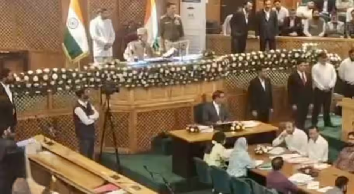

Jammu and Kashmir Legislative Assembly Speaker Abdul Rahim Rather on Thursday pulled up Transport Minister Satish Sharma over the practice of government officers holding additional charges retaining multiple official vehicles, questioning the justification for the arrangement and directing the minister to furnish a detailed action-taken report during the ongoing Assembly session.
The exchange took place during Question Hour after BJP MLA R.S. Pathania asked whether the government had strictly enforced, or proposed to enforce, a “One Officer One Vehicle” ceiling across all departments, Public Sector Undertakings (PSUs), boards and autonomous bodies to curb the retention of multiple official vehicles by individual officers.
Replying to the question, Transport Minister Satish Sharma informed the House that there is currently no specific government policy prescribing a uniform ceiling for the allotment or retention of official vehicles by individual officers across departments of the J&K government.
Sharma said a Revised Car Policy is under consideration, under which the principle of “One Vehicle–One Officer” has been proposed.
The proposed policy would also provide for specific exceptions where necessary, keeping in view security requirements, field duties, additional assignments or charges, operational exigencies and the functional requirements of departments or organisations.
Once approved, the provisions would be implemented across the concerned departments, PSUs, boards and autonomous bodies. Sharma described the existing practice as a “legacy issue” and assured the House that the government would examine and correct it.
He also said a high-level committee had been constituted in the matter on September 1, 2026.
Speaker questions need for multiple vehicles
Speaker Abdul Rahim Rather intervened, questioning the logic of providing separate vehicles to officers who hold additional charges of more than one department.
“Many officers have more than one vehicle because they have more than one department,” Rather said, asking why an officer holding an additional charge should need a separate vehicle belonging to that department when only one individual is travelling.
When Sharma reiterated that it was a legacy issue, the Speaker questioned the rationale of continuing a practice simply because it had existed for years.
“If the legacy issue is wrong, will you follow that?” Rather asked.
Rather seeks action-taken report
The Speaker also questioned the delay, pointing out that a high-level committee had been constituted nearly 24 days earlier.
“You said that a high-level committee has been constituted in the matter on September 1, 2026. Tell me what you have done in these 24 days. Why are you delaying the process? Will you take another two months to resolve the matter?” Rather asked, directing Sharma to inform the House about the action taken.
Rather stressed the government’s financial constraints and the need for rational use of public resources.
“It is a matter of resources. This poor state cannot afford luxuries,” he said.
He also objected to officers and their staff using several vehicles when a single vehicle could potentially serve the purpose.
“It is not a luxury that you will sit in four vehicles with your officers and other people will be worried,” Rather remarked.
Minister assures House of detailed report
The Speaker directed the minister to provide complete details before the House during the ongoing session.
“You will have to come to us in front of this House,” Rather told Sharma.
The minister assured the Speaker that he would study the matter thoroughly and present a detailed action-taken report in the House during the current session.
The episode highlights concerns raised in the Assembly over the rationalisation of government vehicle usage, fiscal prudence and the efficient deployment of public resources in Jammu and Kashmir.
The proposed Revised Car Policy, once finalised and approved, is expected to introduce clearer norms aimed at preventing the retention of multiple vehicles by officers and ensuring optimum utilisation of the available fleet.