
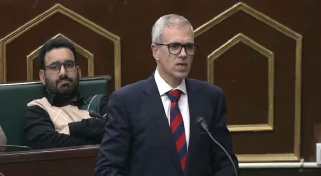

The Jammu and Kashmir Government has screened approximately 21.81 lakh books across government and private college libraries in the Union Territory since July this year and withdrawn 4,812 books found to contain objectionable or banned material. The disclosure was made in a detailed written reply to the Jammu and Kashmir Legislative Assembly
The government’s response came to a question by Awami Ittehad Party (AIP) MLA from Langate, Sheikh Khursheed, who sought clarity on whether the administration had adopted “clear and objective criteria” for identifying objectionable content during the ongoing scrutiny of library collections in higher education institutions.
The government’s reply, tabled during the autumn session of the Assembly in Srinagar, provided the first comprehensive official figures on the scale of the exercise, which began earlier this summer following a controversy over two school library books that profiled separatist leaders as “great personalities.”
The Higher Education Department stated that a total of 21,81,582 books and publications had been examined so far, 12,48,641 in the Kashmir division and 9,32,941 in the Jammu division.
A total of 4,812 books were withdrawn from circulation. This figure includes 518 copies of formally banned titles and 4,249 other books identified as containing objectionable material during the review.
Breaking down the withdrawals further, the government informed the House that the 518 banned books belonged to 19 titles prohibited under Statutory Order (S.O.) 203 dated August 5, 2025. Of these, 40 were removed from institutions in the Jammu division and 478 from the Kashmir division.
The larger category of non-banned but withdrawn books numbered 4,249, including 3,996 from Kashmir and 253 from Jammu.
In addition, 1,752 books of various titles were referred to the Director of Colleges for expert examination, comprising 1,214 from Kashmir and 538 from Jammu. Officials noted that the scrutiny process remains incomplete and described it as a lengthy exercise that requires more time.
Responding directly to MLA Sheikh Khursheed’s query on the standards being applied, the government asserted that “clear and objective criteria” had been adopted for identifying objectionable material during the scrutiny of books available in colleges, in accordance with directions contained in a circular issued by the Higher Education Department.
The exercise is part of a broader academic and content audit ordered in July 2026 after two books supplied under the Samagra Shiksha scheme to school libraries, “Personalities and Legends of J&K” and “Great Personalities of Jammu and Kashmir”, were found to include profiles of separatist figures such as Syed Ali Shah Geelani, Shabir Ahmad Shah, Masarat Alam and Maqbool Bhat.
Those books were withdrawn, several officials were suspended, and the review was rapidly expanded from schools to colleges, universities and publicly funded libraries.
The July circular from the Higher Education Department established a three-tier mechanism involving college-level committees, the directorate and the administrative department. It directed institutions to review not only printed books but also journals, research publications, theses, dissertations and digital repositories for material that is factually inaccurate, misleading, distorted, inflammatory, unlawful or otherwise objectionable, including content that promotes, glorifies or legitimises terrorism, violent extremism, secessionism or radicalisation.
The Education Department, headed by Minister Sakina Itoo, maintained in the Assembly reply that the process is guided by the need to ensure that academic resources align with the Constitution of India, applicable laws, University Grants Commission regulations, the National Education Policy and the educational objectives of the higher education system.
MLA Sheikh Khursheed, however, expressed dissatisfaction with the reply. Speaking outside the House and to media outlets, the AIP legislator alleged that the government had failed to provide specific details such as the titles of the withdrawn books, names of authors, subjects or publishing houses.
He calculated the total removals, banned plus non-banned, at around 6,519 books when including those referred for further examination, and argued that the lack of transparency raised serious questions about the criteria being applied and the potential impact on the preservation of Jammu and Kashmir’s history, literature and academic record.
Khursheed claimed he had heard reports of books related to the Kashmir issue or authored by well-known writers on the region being removed. He said he would continue to pursue the matter.
The Higher Education Department has reiterated that the exercise is ongoing and that the remaining material will continue to be examined under the established framework.