
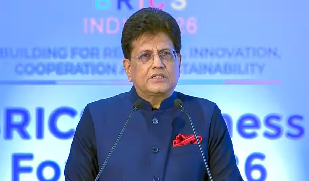

The free trade agreement (FTA) between India and New Zealand will come into force on October 20, Commerce and Industry Minister Piyush Goyal announced on Monday, marking a significant step forward in trade ties between the two countries.
The agreement recently received strong bipartisan backing in the New Zealand Parliament, where 93 lawmakers voted in favour of the deal and 26 voted against it.
“A Vijay for both nations. India-New Zealand FTA coming into force on 20th October 2026, on the occasion of Vijay Dashami,” Goyal said in a post on X.
New Zealand’s Minister for Trade and Investment, Todd McClay, had told IANS last week that the agreement was expected to take effect within a month. He said the next steps involved signing it into law and exchanging diplomatic notes with India.
“The next stage is that we will sign it into law and exchange diplomatic notes with India when they are able to do the same. Then the clock starts ticking for the agreement to enter into force,” McClay said.
“I think we can expect that within the next month,” he added.
Duty-free access for Indian exports
Signed in New Delhi on April 27, the FTA will provide duty-free access for 100 per cent of Indian exports to New Zealand from the date it comes into force.
The agreement is expected to open opportunities for Indian exporters across sectors such as textiles and apparel, leather and footwear, engineering goods, pharmaceuticals, agriculture and processed food.
New Zealand, meanwhile, will receive enhanced and preferential access to the Indian market for products including wood, wool, sheep meat and raw leather hides.
Focus on services, investment and mobility
The agreement also covers services and investment, while creating new opportunities for professional, student and youth mobility. It includes enhanced pathways for Indian professionals and students.
According to the Commerce Ministry, the pact is aimed at facilitating $20 billion in investment into India. It also strengthens cooperation between the two countries in areas such as agricultural productivity, pharmaceuticals and medical devices, traditional medicine and AYUSH, technology and trade facilitation.
India and New Zealand have maintained close ties, supported by strong people-to-people links and growing cooperation in trade and investment, agriculture, education, sports and technology.
(With IANS inputs)