
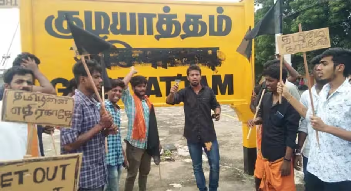

Hearing a matter on the establishment of Jawahar Navodaya Vidyalayas (JNVs) in every district, the Supreme Court has told the Tamil Nadu government that it cannot take the position that Hindi will not be taught anywhere in the state.
A bench of Justices BV Nagarathna and AG Masih on Thursday (September 17) said the state needs to change its approach and work with the Centre on the issue. “It cannot be that Hindi will not be taught in Tamil Nadu. You have to change your mindset,” the bench said during the hearing.
The court also emphasised that Chennai should not be isolated from Delhi, and vice versa. It said Tamil Nadu’s standards will not come down because another form of education is introduced in the state.
The comments came in a long-running dispute over the establishment of JNVs, which are centrally run residential schools aimed largely at students from rural areas.
Why Tamil Nadu opposes Navodaya schools
The state has opposed the setting up of JNVs because of their three-language system, which includes Hindi. The state follows a two-language policy based on Tamil and English and has argued that the Navodaya model does not fit its education policy.
The dispute dates back several years. The Madras High Court had directed the Tamil Nadu government to facilitate the establishment of a Navodaya school in every district. The state challenged that order before the Supreme Court.
The Madras High Court had earlier examined whether the schools would violate the Tamil Nadu Tamil Learning Act, 2006. Its judgment said Tamil is taught as a compulsory subject in JNVs up to grade 10 and that the medium of instruction in the lower classes can be the regional language. The court concluded the Navodaya system does not violate Tamil Nadu’s law or its language policy.
However, the state has continued to oppose the schools. A 2026 government document on the status of JNVs said Tamil Nadu has not accepted the Navodaya scheme, making it the only state without such schools.
SC gives state more time
The Supreme Court had earlier asked the Tamil Nadu government to identify land needed for setting up JNVs in every district. On Thursday, the court refused to withdraw that direction.
The state was given another three months to comply. The latest order follows an earlier direction in December 2025, when the apex asked Tamil Nadu and the Centre to hold consultations over the establishment of JNVs. The court had emphasised the need for cooperation between the Union and state governments. The bench also asked representatives of the Centre and Tamil Nadu to continue talks on the policy for setting up the schools and the language issue.
The court has fixed December 14 for the next hearing.
Tamil Nadu opposes Navodaya model
Appearing for the state, Senior Lawyer Jaideep Gupta told the court that the Navodaya model was against the state’s education policy and could affect the position of the Tamil language.
He argued that cooperative federalism could not work in only one direction. He also said policy decisions of this nature should not be imposed through court orders. The state raised another issue concerning pending payments under the Sarva Shiksha Abhiyan and argued that the Navodaya dispute had a political dimension.
The apex court did not accept the argument that the state could simply refuse to follow the earlier direction. The bench said the state only had to identify land and was not being asked to acquire it immediately.
“We are not asking you to acquire land, only to identify the land,” the bench said, emphasising that the interests of all sides needed to be considered.
Justice Nagarathna also said the Centre and the state should talk about the language issue. The court said Tamil Nadu could raise any unresolved issue before it after talks with the Union government.
Centre says state only needs to provide land
Representing the Centre, Additional Solicitor General KM Nataraj told the court that Tamil Nadu was required to provide land for the schools, while the Union government would take care of the other arrangements.
Justice Nagarathna said both governments would ultimately have to work together. She also said the state should not see cooperation with the Centre as surrendering to it.
The court asked both sides to continue talks instead of treating the dispute as a confrontation between the state and Union governments.