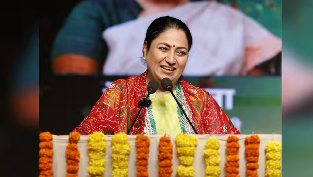

Delhi Chief Minister Rekha Gupta inaugurated a newly constructed public toilet block at Labour Chowk in Singalpur village, Shalimar Bagh, in a move aimed at strengthening basic civic amenities for residents, workers and daily commuters in the area.
The facility has been designed keeping in mind the needs of a growing metropolitan city and includes dedicated amenities for Divyangjan. A caretaker arrangement has also been put in place to ensure regular maintenance and make the facility more accessible and convenient for users.
The inauguration comes as the Delhi Government continues to focus on improving civic infrastructure and expanding access to clean and modern public facilities across the capital. The government said coordinated efforts by various departments are being undertaken to improve basic amenities in different neighbourhoods and enhance the quality of life for residents.
The new public toilet is expected to provide a more accessible and cleaner option for people who live, work or travel through the Labour Chowk area. With public spaces witnessing regular movement of residents and commuters, the availability of properly maintained sanitation facilities remains an important part of urban civic infrastructure.
The Delhi Government said its broader focus is on ensuring that civic amenities keep pace with the requirements of a rapidly growing city. The inclusion of facilities for Divyangjan is also aimed at making public infrastructure more accessible to people with disabilities.
In another civic push, Delhi to get 10 new ‘Arpan Centres’ at metro stations
Alongside the expansion of basic civic amenities, the Delhi Government is also working on initiatives aimed at improving waste management and encouraging the reuse of household material.
Chief Minister Rekha Gupta said that 10 more Arpan Centres would be opened at Delhi Metro stations to facilitate the collection and productive use of old clothes. The existing centres have collected 41,181.59 kg of used clothes from 3,940 people as of August 31.
The Arpan Centres, currently operating at 10 Delhi Metro stations, provide residents with an option to deposit clothes that they no longer need or use. The collected material is subsequently sorted and processed through reuse, upcycling and recycling.
The Baba Saheb Ambedkar Hospital centre recorded the highest collection at 9,861.40 kg, followed by the Shalimar Bagh centre with 9,761.03 kg. The Punjabi Bagh West centre collected 6,534.98 kg, while the Shahdara centre collected 6,386.08 kg.
The other centres recorded collections of 5,189.40 kg at Mayur Vihar-I, 1,680.70 kg at Hauz Khas, 689.40 kg at Dwarka-Kakrola, 467.40 kg at Malviya Nagar, 395.70 kg at Lajpat Nagar and 215.50 kg at Mohan Estate. Five centres were launched on August 3, while the remaining centres became operational on August 12 and 17.
To expand the initiative, the government has proposed 10 additional Arpan Centres, which are scheduled to open in January 2027. The proposed locations include Model Town, INA, IP Extension, Paschim Vihar West, Rajendra Place, Janakpuri West, Rajouri Garden, Greater Kailash, Dwarka Sector 10 and Chhatarpur Metro stations.
According to the government, around 4,266 kg of the material collected at the centres had been earmarked for reuse or upcycling, while 29,424 kg was sent for recycling as of August 31.
Self-help groups are using some of the collected clothes to make products such as rugs, folders, key rings, pouches, bags and torans. These products are displayed at the Arpan Centres and are also being sold. The 10 centres have recorded total sales of Rs 27,036.
Gupta said the Arpan Centres provide a practical way for people to dispose of old clothes while ensuring that the material is put to productive use instead of becoming waste.
She also encouraged Delhi residents to participate in the initiative, saying wider public participation could help expand the system and ensure the maximum utilisation of old clothes.
The two initiatives — improved public sanitation facilities and the expansion of Arpan Centres — form part of the Delhi Government’s stated effort to strengthen civic infrastructure while promoting cleaner and more sustainable urban practices across the capital.