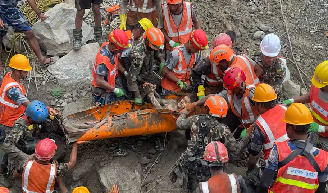

A WhatsApp group created by engineers shortly before disaster struck Nepal’s Trishuli valley has become an unlikely but vital source of help for rescuers searching tunnels buried beneath tonnes of mud, rocks and debris. The group has more than 500 members, including engineers, former hydropower workers, government officials and other experts. As rescue teams struggle to reach workers trapped inside damaged hydropower projects, members are sharing tunnel maps, plant drawings and their knowledge of the facilities.
The August 26 disaster sent a huge wall of water, mud and rocks through the valley after a glacial and mountain collapse near the Nepal-China (Tibet) border. Official records put the death toll at least 1,287, while thousands remain missing.
According to a Reuters report, the engineers’ group has become a real-time support network for rescuers. When teams encounter a problem at a damaged plant, they post questions in the group and someone with knowledge of the facility tries to provide an answer.
Engineers guide rescuers through buried tunnels
The importance of the group became clear last week when rescuers were searching the buried Chilime hydropower plant near the Chinese border.
A government official posted a simple request: “Can you send me Chilime layout drawings.”
Within minutes, a member shared drawings of the powerhouse along with details of the access tunnels.
Such information can make a crucial difference when familiar routes have been buried or altered by floodwater and debris. Engineers are providing maps showing where tunnels lead, where chambers are located and how different sections of the plants are connected.
Former employees are also helping from their own experience. Having worked inside the facilities, they can offer rescuers details that may not be available from damaged or buried plans.
The group is also being used to trace missing workers. Members share names and mobile numbers with officials, who can then pass the information to telecom authorities. Last recorded mobile phone locations could help establish where workers were when the disaster struck.
“The flood has altered the terrain around the tunnels and changed their structure, while mud, rocks, soil and other debris had accumulated inside,” Nepal Army spokesperson Raja Ram Basnet told Reuters. “This is not a normal closure of tunnels.”
Rescuers refuse to give up hope
The search has become particularly urgent at Chilime and Rasuwagadhi hydropower plants.
Nepal’s Independent Power Producers’ Association said at least eight people could be trapped at Chilime, while a Nepal Electricity Authority official estimated that as many as 46 workers could be trapped at Rasuwagadhi further south.
At Rasuwagadhi, rescuers managed to get about 250 metres into one tunnel before their path was blocked. The operation, however, has continued.
“We are trying to reach there inside again to look for people,” Nepal Electricity Authority board member Amshu Kiran Shahi said.
He said the 46 workers could be trapped inside a chamber where food and water may still be available.
A Nepal Electricity Authority manager said rescuers had also used the WhatsApp group to seek advice from former plant workers, who supplied drawings and other information about the tunnels.
At Upper Trishuli 3A, rescuers spent nearly six days trying to reach a buried tunnel. Oxygen was pumped into possible cavities in the hope that workers might still be alive.
Then, on Friday, came a breakthrough.
Two workers were pulled out alive after spending nine days inside the tunnel. They were identified as 30-year-old mechanical foreman Sanjay Sah and 45-year-old mechanical supervisor Kabir Maharjan.
“As long as there is breath, there is hope!” Energy Minister Biraj Bhakta Shrestha said in a statement. “Rescue operations are continuing in all the affected tunnels. Let everyone’s efforts and prayers continue. We have not lost hope.”
The rescue of Sah and Maharjan brought a rare moment of relief amid the devastation. The Nepali Army called the operation a “miraculous victory of hope”. Amir Maharjan, the brother of rescued worker Kabir Maharjan, said he was overwhelmed by the news.
Lakshmi Naini, who said Maharjan was her brother-in-law, had been waiting outside a hospital in Kathmandu when she learnt that he had survived.
The rescue efforts have also highlighted the courage of workers who stayed behind to help others escape. A mechanical foreman said he remained in a control room after hearing about the disaster and told his colleagues to flee.
“I was in the control room, so my responsibility was to save everyone’s lives. When there was such a big accident, it was not right for me to run away,” he said, according to Reuters.
The engineers’ WhatsApp group is now working alongside helicopters, excavators, oxygen pipes and rescue teams at the disaster sites. Its members may be far from the tunnels, but their knowledge of what lies beneath the rubble is proving invaluable.
Nepal flood death toll
The disaster began on August 26 when a massive glacial and rock collapse on a mountain near the China-Nepal border sent a surge of water, ice, mud and debris down the Trishuli valley.
Nepal’s Foreign Minister Shisir Khanal described the wave as a “Himalayan tsunami”.
Nepal’s disaster authority said 1,259 bodies had been recovered and 5,083 people remained missing. China reported 21 deaths and 541 people missing in Tibet, taking the combined toll to 1,287 dead and 5,624 missing.
More than 800 foreigners from at least 34 countries are among those missing across Nepal and Tibet. With families going days without news of their loved ones, some have already begun holding symbolic funerals. Yet inside the damaged tunnels, rescuers are still searching.
And after two workers emerged alive nine days after the disaster, the message from those involved remains simple: as long as there is a chance someone is alive, the search must go on.