
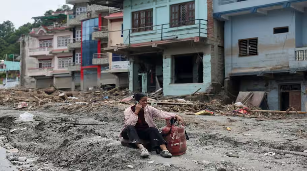

Following the August 26 flash floods in Nepal that have killed over 1,200 people and left nearly 4,000 missing, Foreign Minister Shishir Khanal has called for climate compensation from the United States, China and India. Triggered by a massive rock and ice collapse near the Nepal-Tibet border, the floods destroyed homes, bridges and hydropower infrastructure across the affected areas.
In an interview with local television channel Kantipur TV, he said, “We are shifting our diplomatic framework from aid to justice and compensation. This is not a matter of charity; it is a matter of moral and legal liability. The major industrial emitters – such as China, which is world’s top emitter, the United States at number 2 and India at number 3 – have a historical responsibility to compensate vulnerable nations like Nepal.”
His claim needs to be viewed against the difference between present-day emissions and cumulative emissions since the beginning of industrialisation. China, the United States and India are among the biggest emitters today, but their shares of historical CO2 emissions are very different.
That distinction is important because climate change did not begin in the past few years. Scientists assessing historical responsibility look at cumulative emissions or the total amount of greenhouse gases a country has released over a long period. The CO2 released since the Industrial Revolution has contributed to the rise in temperatures across the planet.
India’s historical emissions trail US and China
Data cited by the United Nations Environment Programme for the period from 1850 to 2022 shows how different the picture looks when cumulative emissions are considered.
The United States accounts for about 20 per cent of historical CO2 emissions during that period. China accounts for around 12 per cent, while the European Union is also at about 12 per cent. Russia accounts for roughly 7 per cent and Brazil for about 5 per cent.
India’s share is around 3 per cent.
This means India is one of the world’s biggest present-day emitters because of its large population, strong economy and rising energy demand. Its historical contribution to cumulative emissions is far smaller than that of the United States and several other early industrial powers.
Putting it in exactly the same historical category as the United States and China therefore does not fit the cumulative emissions data.
That does not weaken Nepal’s argument for climate compensation. The issue is part of a larger demand from developing countries that have contributed relatively little to global warming but face heavy costs from floods, droughts, rising temperatures, melting glaciers and other climate-related disasters.
The loss and damage question
Climate negotiations have a term for this problem – loss and damage.
The basic idea is straightforward. If a climate-related disaster destroys homes, roads, farms and sources of income in a vulnerable developing country, the country facing that damage may argue that it should not have to carry the entire financial burden.
This issue led to the establishment of the Loss and Damage Fund at COP27, the 27th Conference of the Parties to the UN Framework Convention on Climate Change (UNFCCC) that was held in Egypt’s Sharm el-Sheikh from November 6-20, 2022.
The participating countries agreed to create a dedicated Loss and Damage Fund to provide financial assistance to developing countries that are vulnerable to climate change and suffer losses from climate-related disasters such as floods and droughts.
Nepal would still have to prove a direct connection between specific climate-related damage and the climate responsibilities of particular countries. That would require evidence showing that the damage was sufficiently attributable to climate change.
That is where the politics becomes complicated.
A 2026 study on climate research found that about 93 per cent of researchers involved in top climate research come from developed countries. Much of the world’s expertise, data infrastructure and research capacity is therefore concentrated in countries that also have a major role in talks on historical emissions and climate finance.
Countries such as Nepal need stronger research capacity of their own. Local scientific institutions can document changes in glaciers, rainfall, floods, temperatures and other climate risks. This evidence can help establish the scale and nature of the losses they face.
India’s own climate research infrastructure has also struggled in recent years. A report titled ‘India losing ability to build its own instruments: climate science report’ has highlighted problems surrounding the country’s ability to develop and maintain its own scientific instruments and research capabilities.
The issue has consequences across South Asia. The United States, European countries, China and Russia account for large portions of historical emissions, while countries across the Global South face many of the consequences of a warming planet.
Nepal’s demand for climate justice is part of that larger fight. The difficult question for the region is how countries such as Nepal, India and Pakistan can build the scientific evidence and institutional capacity needed to measure climate damage, establish responsibility and secure financial support.