
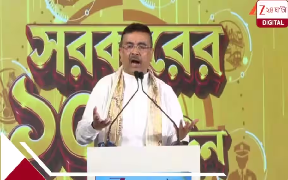

Speaking at the Zee 24 Ghanta Mega Conclave, the Chief Minister, Suvendu Adhikari, reiterated that the performance assessment cannot be limited to the time frame of only 100 days. He highlighted the fact that the previous government had left the state in a financially bankrupt position, and thus the first and foremost thing is to repair the administrative damage and make the state self-reliant.
Three new committees were formed for investigating the corruption cases and industrial upgrade.
According to the statement made by the Chief Minister, three different committees have been formed in order to deal with the issues arising from the infrastructure and administration of the state in the past.
Upgrade of industries: One committee will be looking after the reasons behind the closure of industries/biz and preparing for a new industrial policy.
Previous corruption case investigations: The other two committees will be investigating all the cases of corruption and illegal decisions in the previous government.
Leadership: These three committees will be headed by Tapas Roy, Swapan Dasgupta, and Manoj Agarwal.
No discrimination in treatment
Attacking directly the opposition Trinamool Congress (TMC), Adhikari said that the new system will be free from the old politics of appeasement and that everybody will be treated equally without any discrimination.
The Jadavpur warning: Stating his displeasure with the use of anti-national slogans and walls defaced with radical markings in Jadavpur, the Chief Minister said a warning that there would be no place for “intellectual Naxals” or supporters of Kishenji in West Bengal.
Noting that governance should focus on transparency in the interest of public welfare and not in the form of divisive politics, Adhikari rejected the divisive culture.
Six key points for the development of the state
Charting out the future course of action, the Chief Minister outlined six key areas in which state policy should be shaped in the coming days:
1. National security: Highest emphasis on border security and internal security.
2. Constitutional responsibilities: Adherence to constitutional systems and democratic principles.
3. Centrally integrated: Active participation in all centrally sponsored welfare and developmental schemes.
4. Direct welfare: Direct benefit transfer for all grassroots welfare schemes.
5. Tertiary employment: Creating tertiary employment opportunities.
6. Investor-friendly environment: Creating an open and clean atmosphere for inviting new investment.